Every household should be more careful in the way that they of waste
Every household should be more careful in the way that they of waste
Every household should be more careful in the way that they of waste

Welcome to Madeleine Olivia! Explore my blog for:
Plant based recipes, minimalism & sustainability, slow living & home
Find me on my socials.

Apr 27 30 Easy Ways To Reduce Your Waste
There is a waste crisis on our planet today, with plastic everywhere we look. And it is our responsibility, as individuals, to do something about it. I have become increasingly aware of my own personal impact, especially since going vegan and embarking on minimalism, and found different ways to make small but significant changes to my lifestyle to reduce my waste.
Having said that, I’m not perfect. And if you’re looking to reduce your waste, try not to beat yourself up if you try and fail, over and over again. It’s a battle against a system that doesn’t seem to care at all about the waste we’re producing or the impact we’re having. Just do your best to reduce in the ways that make sense for your lifestyle. If we were all to do that, we’d make a considerable joint effort towards reducing our overall waste.
That’s why I wanted to put together 30 ways in which you can reduce your waste, very easily. There will be at least a few things on this list that you can change today to make a difference to your personal waste footprint.

1. Stop buying stuff
One of the biggest things you can do to reduce your waste, is to simply stop buying so much stuff. When you’re buying new things, you’re creating demand for that thing, as well as creating demand for its journey of production and the waste that comes along with it. Simply saying no to things you don’t need, and being appreciative for what you already have is one of the biggest steps you can take to reducing your waste.
2. Avoid food wrapped in plastic
Sadly most food these days is wrapped in plastic. The UK alone produces more than 170 tonnes of waste every year, much of which is food packaging. And if you were to look in your bin right now, I’m sure a lot, if not most, of it is plastic that was wrapping your food. For me, this is one of the biggest struggles I am working on in my day-to-day life, as supermarkets cover everything in plastic. You can’t always win, but do your best to seek out foods that aren’t wrapped in plastic.
3. bring your own bag
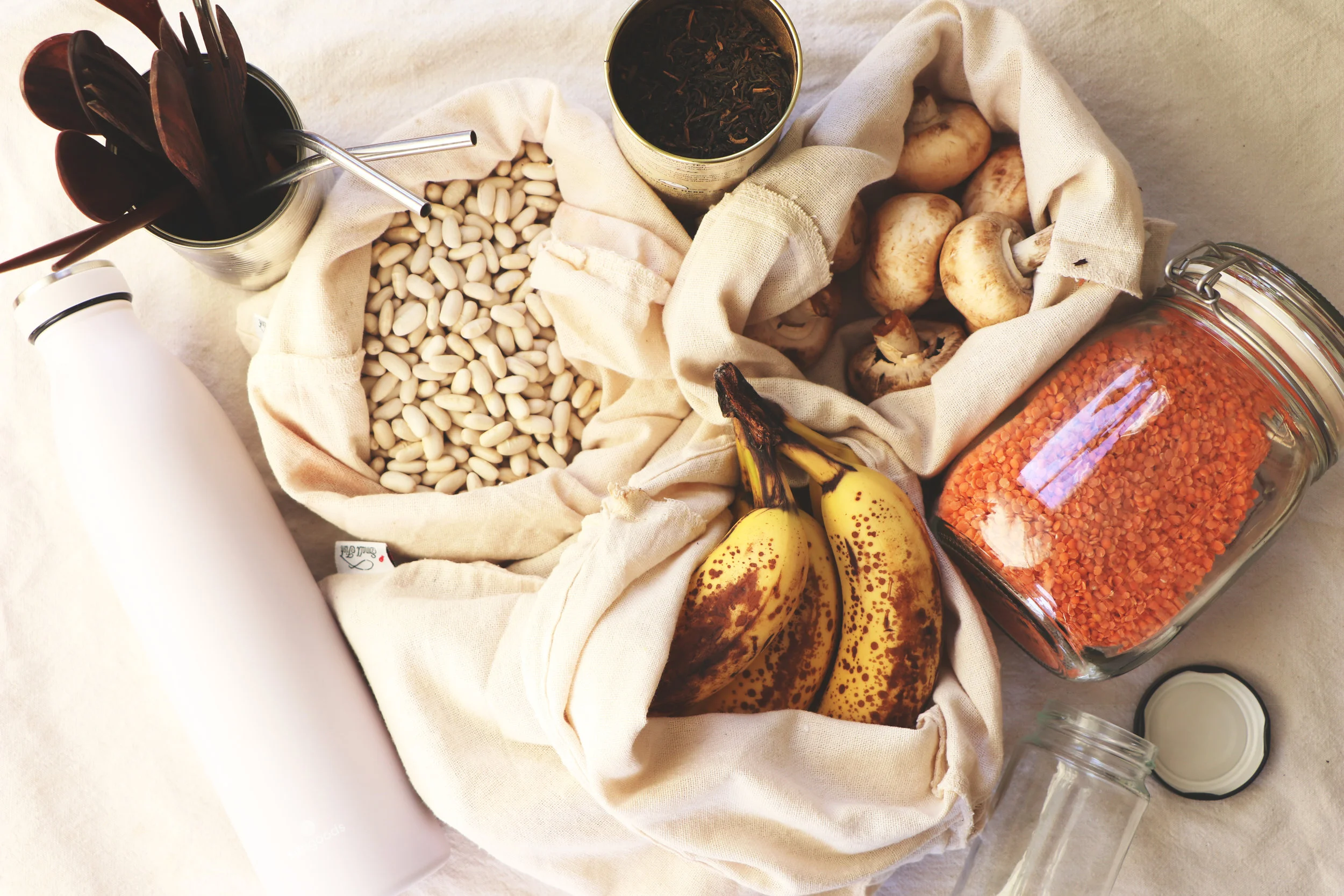
When you leave the house, make sure to bring your own bag. Plastic bags need to be a thing of the past, and instead we need to all be bringing our own reusable option. I have these really great cotton bags that are perfect for loose fruit and veg, and I am usually wearing a backpack when I’m out and about so I always have somewhere to put anything I am buying. I love these colourful motivational bags designed in Cornwall. The perfect size for carrying food or shopping home. Remember, if worst comes to worst and you forget, just carry the items! Don’t be embarrassed to say no to single use plastic, and use your arms instead.
4. Shop local
Not only is it better to support the local economy, but local markets and stores often use a lot less plastic to wrap their foods. So get organised, and try planning your weekly shop to visit the local farmer’s market or green grocer’s before heading to the supermarket. This is how we have been doing it for a while now, and it’s a great way to find more zero waste options, get bargains on fruit and veg, as well as experiencing a sense of community from shopping locally.
5. Buy things in bulk
Look up online to see if there is anywhere locally that you can buy foods in bulk. Take your own containers, and stock up on the essentials without the extra packaging! I’ve been buying toilet roll in bulk for a while now from Who Gives A Crap.
6. Avoid single use items/foods
Try avoiding items like plastic cutlery, straws, plates, cups and single use food items like pre-packaged salads, sandwiches, dressing, yoghurts etc. These things are easily replaced by reusable, or multi-purpose options, simply by staying prepared and saying no.
7. Get your own reusable bottle
Plastic bottles can take up to 450 years to break down, so its more important than ever that we stop buying plastic water bottles, and bring our own reusable versions. I have this amazing water bottle from Contigo which I take with me everywhere. I take my water bottle with me everywhere I go, and simply ask kindly at cafs or restaurants for them to refill it for me, or fill it up myself at a refill station. So if you’re new to the low waste lifestyle, getting your own water bottle is great place to start. For more sustainable products check out my Zero Waste Products I can’t Live Without blogpost.

8. Reusable cutlery and storage containers
When avoiding single use items, it’s important to bring your own! I’ve had a set of reusable cutlery for years, and I use them out and about, as well as at home. I also picked up a super handy cutlery set before my travels (although I ended up losing the spoon, so replaced the cutlery with this set from Coconut Bowls). They’re super easy to grab and throw in your bag when you’re heading out, so you can avoid plastic spoons and forks. The same goes for containers. Grab whatever containers you already have, throw them in your bag when you know you’re going to be eating food out that day that will potentially come in plastic packaging, and kindly ask for them to use your container instead. These simple swaps will very quickly make a huge impact on your overall waste production.
9. say no straws
It can be an easy one to forget, but try practicing saying no to straws when you order a drink. As adults, we really don’t need to drink our drinks through straws. So bring your own or simply say no to avoid that extra plastic.
10. Drink loose leaf tea
I only recently made this switch, because I found out that teabags have plastic in them! I’ve been really enjoying drinking loose leaf tea from a teapot with an infuser, and if you drink a lot of tea like me, then that’s saving a lot of waste.

11. Thrift shop/charity shop
Buying secondhand clothes is always better than buying new, plus it saves you money. The fast fashion industry is one of the most destructive on our planet, and we’re buying more clothing than ever before, with the world consuming over 80 billion pieces of clothing every year. So the solution is to ditch fast fashion and opt for secondhand instead. Next time you’re after a new jumper, jacket or summer dress, visit your local thrift/charity shop, or look on secondhand apps such as Depop or eBay to see what gems they have (and grab yourself a bargain!). Check out my guide about How to Shop Sustainable Shopping.
12. Buy secondhand electronics
I recently got my new camera setup for a fraction of the price simply by buying it secondhand, saving around £500. So similarly to clothes, next time you’re in need of a new electronic device, have a look around to see what you can buy secondhand. You’d be surprised how many people are selling electronics that are as good as new, for a fraction of the price.
13. Compost your food waste
If you aren’t composting, then most of the weight in your rubbish bin is likely coming from food scraps. Unfortunately, when food waste goes to landfill, it can’t decay properly and therefore produces methane, a greenhouse gas. If you compost, you’re therefore reducing these emissions that are going into the environment. So if you have a garden, get composting, or if not, see what other solutions there are for you. Where we live, they don’t collect food waste, so we rang the council to join a local composting scheme across the city’s gardens. We simply collect our food scraps, and take it to the compost bins at our local garden to be composted.
14. Don’t throw away your food
15. Meal plan
As aforementioned, meal planning can go a long way to reducing your food waste. Becoming organised with what you’re going to eat during the week makes sure you’re not over-purchasing on foods that you won’t eat, or will go off, and end up in the bin. Simply spend 10-15 minutes each week sitting down to meal plan what you’re going eat that week, and create a shopping list. You can even go one step further and meal prep your foods to ensure you don’t buy plastic-packaged foods when you’re out and about!
Every household should be more careful in the way that they of waste

Every household should be more careful in the way that they ________ of waste.


B. throw (v): vứt bỏ
D. dispose (v): vứt đi
Tạm dịch: Mỗi hộ gia đình đều nên xử lí rác thải cẩn thận hơn.
Read the following passage and mark the letter A, B, C or D to indicate the correct answer to each of the questions from 43 to 50.
If it is a matter of right answers, as it may be in mathematics or science, give him the answer book. Let him correct his own papers. Why should we teachers waste time on such routine work? Our job should be to help the child when he tells us that he can’t find the way to get the right answer. Let’s end all this nonsense of grades, exams, and marks. Let us throw them all out, and let the children learn what all educated persons must someday learn, how to measure their own understanding, how to know what they know or do not know.
Let them get on with this job in the way that seems most sensible to them, with our help as school teachers if they ask for it. The idea that there is a body of knowledge to be learnt at school and used for the rest of one’s life is nonsense in a world as complicated and rapidly changing as ours. Anxious parents and teachers say, «But suppose they fail to learn something essential, something they will need to get on in the world?» Don’t worry! If it is essential, they will go out into the world and learn it.
Exams, grades and marks should be abolished because children’s progress should only be estimated by _____________.
B. the children themselves
D. educated persons
Read the following passage and mark the letter A, B, C or D to indicate the correct answer to each of the questions from 43 to 50.
If it is a matter of right answers, as it may be in mathematics or science, give him the answer book. Let him correct his own papers. Why should we teachers waste time on such routine work? Our job should be to help the child when he tells us that he can’t find the way to get the right answer. Let’s end all this nonsense of grades, exams, and marks. Let us throw them all out, and let the children learn what all educated persons must someday learn, how to measure their own understanding, how to know what they know or do not know.
Let them get on with this job in the way that seems most sensible to them, with our help as school teachers if they ask for it. The idea that there is a body of knowledge to be learnt at school and used for the rest of one’s life is nonsense in a world as complicated and rapidly changing as ours. Anxious parents and teachers say, «But suppose they fail to learn something essential, something they will need to get on in the world?» Don’t worry! If it is essential, they will go out into the world and learn it.
What does the author think teachers do which they should not do?
B. They point out children’s mistakes to them
Read the following passage and mark the letter A, B, C or D to indicate the correct answer to each of the questions from 43 to 50.
If it is a matter of right answers, as it may be in mathematics or science, give him the answer book. Let him correct his own papers. Why should we teachers waste time on such routine work? Our job should be to help the child when he tells us that he can’t find the way to get the right answer. Let’s end all this nonsense of grades, exams, and marks. Let us throw them all out, and let the children learn what all educated persons must someday learn, how to measure their own understanding, how to know what they know or do not know.
Let them get on with this job in the way that seems most sensible to them, with our help as school teachers if they ask for it. The idea that there is a body of knowledge to be learnt at school and used for the rest of one’s life is nonsense in a world as complicated and rapidly changing as ours. Anxious parents and teachers say, «But suppose they fail to learn something essential, something they will need to get on in the world?» Don’t worry! If it is essential, they will go out into the world and learn it.
What does the author think is the best way for children to learn things
B. By making mistakes and having them corrected.
Read the following passage and mark the letter A, B, C or D to indicate the correct answer to each of the questions from 43 to 50.
If it is a matter of right answers, as it may be in mathematics or science, give him the answer book. Let him correct his own papers. Why should we teachers waste time on such routine work? Our job should be to help the child when he tells us that he can’t find the way to get the right answer. Let’s end all this nonsense of grades, exams, and marks. Let us throw them all out, and let the children learn what all educated persons must someday learn, how to measure their own understanding, how to know what they know or do not know.
Let them get on with this job in the way that seems most sensible to them, with our help as school teachers if they ask for it. The idea that there is a body of knowledge to be learnt at school and used for the rest of one’s life is nonsense in a world as complicated and rapidly changing as ours. Anxious parents and teachers say, «But suppose they fail to learn something essential, something they will need to get on in the world?» Don’t worry! If it is essential, they will go out into the world and learn it.
The word «complicated» in the third paragraph is closest in meaning to ___________.
Read the following passage and mark the letter A, B, C or D to indicate the correct answer to each of the questions from 43 to 50.
If it is a matter of right answers, as it may be in mathematics or science, give him the answer book. Let him correct his own papers. Why should we teachers waste time on such routine work? Our job should be to help the child when he tells us that he can’t find the way to get the right answer. Let’s end all this nonsense of grades, exams, and marks. Let us throw them all out, and let the children learn what all educated persons must someday learn, how to measure their own understanding, how to know what they know or do not know.
Let them get on with this job in the way that seems most sensible to them, with our help as school teachers if they ask for it. The idea that there is a body of knowledge to be learnt at school and used for the rest of one’s life is nonsense in a world as complicated and rapidly changing as ours. Anxious parents and teachers say, «But suppose they fail to learn something essential, something they will need to get on in the world?» Don’t worry! If it is essential, they will go out into the world and learn it.
The passage suggests that learning to speak and learning to ride a bicycle are _________.
B. more important than other skills.
Read the following passage and mark the letter A, B, C or D to indicate the correct answer to each of the questions from 43 to 50.
If it is a matter of right answers, as it may be in mathematics or science, give him the answer book. Let him correct his own papers. Why should we teachers waste time on such routine work? Our job should be to help the child when he tells us that he can’t find the way to get the right answer. Let’s end all this nonsense of grades, exams, and marks. Let us throw them all out, and let the children learn what all educated persons must someday learn, how to measure their own understanding, how to know what they know or do not know.
Let them get on with this job in the way that seems most sensible to them, with our help as school teachers if they ask for it. The idea that there is a body of knowledge to be learnt at school and used for the rest of one’s life is nonsense in a world as complicated and rapidly changing as ours. Anxious parents and teachers say, «But suppose they fail to learn something essential, something they will need to get on in the world?» Don’t worry! If it is essential, they will go out into the world and learn it.
The author fears that children will grow up into adults who are _________
B. too independent of others
C. unable to use basic skills
D. too critical of themselves
Read the following passage and mark the letter A, B, C or D to indicate the correct answer to each of the questions from 43 to 50.
If it is a matter of right answers, as it may be in mathematics or science, give him the answer book. Let him correct his own papers. Why should we teachers waste time on such routine work? Our job should be to help the child when he tells us that he can’t find the way to get the right answer. Let’s end all this nonsense of grades, exams, and marks. Let us throw them all out, and let the children learn what all educated persons must someday learn, how to measure their own understanding, how to know what they know or do not know.
Let them get on with this job in the way that seems most sensible to them, with our help as school teachers if they ask for it. The idea that there is a body of knowledge to be learnt at school and used for the rest of one’s life is nonsense in a world as complicated and rapidly changing as ours. Anxious parents and teachers say, «But suppose they fail to learn something essential, something they will need to get on in the world?» Don’t worry! If it is essential, they will go out into the world and learn it.
The word «he» in the first paragraph refers to ___________.
B. their own work
Read the following passage and mark the letter A, B, C or D to indicate the correct answer to each of the questions from 43 to 50.
If it is a matter of right answers, as it may be in mathematics or science, give him the answer book. Let him correct his own papers. Why should we teachers waste time on such routine work? Our job should be to help the child when he tells us that he can’t find the way to get the right answer. Let’s end all this nonsense of grades, exams, and marks. Let us throw them all out, and let the children learn what all educated persons must someday learn, how to measure their own understanding, how to know what they know or do not know.
Let them get on with this job in the way that seems most sensible to them, with our help as school teachers if they ask for it. The idea that there is a body of knowledge to be learnt at school and used for the rest of one’s life is nonsense in a world as complicated and rapidly changing as ours. Anxious parents and teachers say, «But suppose they fail to learn something essential, something they will need to get on in the world?» Don’t worry! If it is essential, they will go out into the world and learn it.
According to the first paragraph, what basic skills do children learn to do without being taught?
Every household should be more careful in the way that they of waste

Every household should be more careful in the way that they ________ of waste.
A. eliminate
B. throw
C. disposal
D. dispose

A. eliminate (v): loại bỏ
C. disposal (n): sự vứt đi
Mark the letter A, B, C or D on your answer sheet to indicate the correct answer to each of the following questions.
In the world today, particular in the two most industrialized areas, North America and Europe, recycling is the big news. People are talking about it, practicing it, and discovering new ways to be sensitive to the environment. Recycling means finding ways to use products a second time. The motto of the recycling movement is “Reduce, Reuse, Recycle”.
The second step is to reuse. It is better to buy juices and soft drinks in returnable bottles. After customers empty the bottles, they return them to the stores. The manufacturers of the drinks collect bottles, wash them, and then fill them again. The energy that is necessary to make new bottles is saved. In some parts of the world, returning bottles for money is a common practice. In those places, the garbage dumps have relatively little glass and plastic from throw-away bottles.
The third step being environmentally sensitive is to recycle. Spent motor oil can be cleaned and used again. Aluminum cans are expensive to make. It takes the same amount of energy to make one aluminum can as it does to run a color TV set for three hours. When people collect and recycle aluminum (for new cans), they help save one of the world’s precious resources
It is a waste when customers buy low-quality products because _______
A. they have to be repaired many times
B. they will soon throw them away.
C. customers always change their idea
D. they are very cheap
In the world today, particular in the two most industrialized areas, North America and Europe, recycling is the big news. People are talking about it, practicing it, and discovering new ways to be sensitive to the environment. Recycling means finding ways to use products a second time. The motto of the recycling movement is “Reduce, Reuse, Recycle”.
The second step is to reuse. It is better to buy juices and soft drinks in returnable bottles. After customers empty the bottles, they return them to the stores. The manufacturers of the drinks collect bottles, wash them, and then fill them again. The energy that is necessary to make new bottles is saved. In some parts of the world, returning bottles for money is a common practice. In those places, the garbage dumps have relatively little glass and plastic from throw-away bottles.
The third step being environmentally sensitive is to recycle. Spent motor oil can be cleaned and used again. Aluminum cans are expensive to make. It takes the same amount of energy to make one aluminum can as it does to run a color TV set for three hours. When people collect and recycle aluminum (for new cans), they help save one of the world’s precious resources
People can do the following to reduce waste EXCEPT _______.
A. buy high-quality products
B. buy simply-wrapped things
C. reuse cups
D. buy more hamburgers
In the world today, particular in the two most industrialized areas, North America and Europe, recycling is the big news. People are talking about it, practicing it, and discovering new ways to be sensitive to the environment. Recycling means finding ways to use products a second time. The motto of the recycling movement is “Reduce, Reuse, Recycle”.
The second step is to reuse. It is better to buy juices and soft drinks in returnable bottles. After customers empty the bottles, they return them to the stores. The manufacturers of the drinks collect bottles, wash them, and then fill them again. The energy that is necessary to make new bottles is saved. In some parts of the world, returning bottles for money is a common practice. In those places, the garbage dumps have relatively little glass and plastic from throw-away bottles.
The third step being environmentally sensitive is to recycle. Spent motor oil can be cleaned and used again. Aluminum cans are expensive to make. It takes the same amount of energy to make one aluminum can as it does to run a color TV set for three hours. When people collect and recycle aluminum (for new cans), they help save one of the world’s precious resources
What is the topic of the passage?
A. How to live sensitively to the environment
B. How to reduce garbage disposal
C. What is involved in the recycling movement
D. What people understand the term “recycle”
In the world today, particular in the two most industrialized areas, North America and Europe, recycling is the big news. People are talking about it, practicing it, and discovering new ways to be sensitive to the environment. Recycling means finding ways to use products a second time. The motto of the recycling movement is “Reduce, Reuse, Recycle”.
The second step is to reuse. It is better to buy juices and soft drinks in returnable bottles. After customers empty the bottles, they return them to the stores. The manufacturers of the drinks collect bottles, wash them, and then fill them again. The energy that is necessary to make new bottles is saved. In some parts of the world, returning bottles for money is a common practice. In those places, the garbage dumps have relatively little glass and plastic from throw-away bottles.
The third step being environmentally sensitive is to recycle. Spent motor oil can be cleaned and used again. Aluminum cans are expensive to make. It takes the same amount of energy to make one aluminum can as it does to run a color TV set for three hours. When people collect and recycle aluminum (for new cans), they help save one of the world’s precious resources
What are the two things mentioned as examples of recycling?
A. TV sets and aluminum cans
B. Hamburger wrappings and spent motor oil
C. Aluminum cans and plastic wrappings
D. Aluminum cans and spent motor oil
In the world today, particular in the two most industrialized areas, North America and Europe, recycling is the big news. People are talking about it, practicing it, and discovering new ways to be sensitive to the environment. Recycling means finding ways to use products a second time. The motto of the recycling movement is “Reduce, Reuse, Recycle”.
The second step is to reuse. It is better to buy juices and soft drinks in returnable bottles. After customers empty the bottles, they return them to the stores. The manufacturers of the drinks collect bottles, wash them, and then fill them again. The energy that is necessary to make new bottles is saved. In some parts of the world, returning bottles for money is a common practice. In those places, the garbage dumps have relatively little glass and plastic from throw-away bottles.
The third step being environmentally sensitive is to recycle. Spent motor oil can be cleaned and used again. Aluminum cans are expensive to make. It takes the same amount of energy to make one aluminum can as it does to run a color TV set for three hours. When people collect and recycle aluminum (for new cans), they help save one of the world’s precious resources
Which area is considered one of the most industrialized?
A. South America
B. Middle East
C. Europe
D. Asia
In the world today, particular in the two most industrialized areas, North America and Europe, recycling is the big news. People are talking about it, practicing it, and discovering new ways to be sensitive to the environment. Recycling means finding ways to use products a second time. The motto of the recycling movement is “Reduce, Reuse, Recycle”.
The second step is to reuse. It is better to buy juices and soft drinks in returnable bottles. After customers empty the bottles, they return them to the stores. The manufacturers of the drinks collect bottles, wash them, and then fill them again. The energy that is necessary to make new bottles is saved. In some parts of the world, returning bottles for money is a common practice. In those places, the garbage dumps have relatively little glass and plastic from throw-away bottles.
The third step being environmentally sensitive is to recycle. Spent motor oil can be cleaned and used again. Aluminum cans are expensive to make. It takes the same amount of energy to make one aluminum can as it does to run a color TV set for three hours. When people collect and recycle aluminum (for new cans), they help save one of the world’s precious resources
What best describe the process of reuse?
A. The bottles are filled again after being returned, collected and washed
B. The bottles are collected, washed, returned and filled again
C. The bottles are washed, returned filled again and collected
D. The bottles are collected, returned, filled again and washed
| Полезный совет! Переводы упражнений в решебнике более актуальны и правильные, чем здесь. Перейти в решебник. |
1. Сопоставьте слова. Затем, используйте фразы для того, чтобы дополнить предложение.
1 энергия
2 растительный
3 чрезмерный
4 упакованый
5 оберточная
6 компост
а бумага
б упаковка
с пилинги
d куча
е обед
f потребление
1 Убедитесь, что вы использовали обе стороны от оберточной бумаги, прежде чем утилизировать ее.
2 Важно, что мы стараемся сократить потребление энергии для того, чтобы спасти планету.
3 Упакованный обед обычно состоит из сэндвича, фрукта и напитка.
4 Жаль, что большинство людей, кажется, не понимают, что растительные пилинги можно использовать для приготовления компоста.
5 Моему деду никогда не нужно покупать удобрения для своего сада, так как у него есть большая куча компоста.
6 Не покупайте ничего, что приходит в чрезмерной упаковке.
Посмотреть ответ
3 Вставьте в пропуски: down on, away, down, off, on.
1 Прежде, чем выбросить какую-нибудь вещь, подумайте о возможности ее вторичного использования
2 Выключайте лампочки, компьютеры, телевизоры и другое. Когда вы их не используете.
3 Выключите отопление и вместо этого наденьте теплую одежду в зимний период.
4 Попробуйте сократить упаковку и бумагу.
Посмотреть ответ
5 Выберете лучший ответ А, В, С или D для промежутков 1-7.
Тувалу это крошечный остров в Тихом океане, между Австралией и Гавайями. Там образуется выбросов углекислого газа меньше, чем в маленьком городке в Америке, но ученые предсказывают, что Тувалу станет одним из первых мест, которое исчезнет из-за глобального
потепления. К сожалению, большая часть территории Тувалу не более чем на метр над уровнем моря, что значит, что этот уровень будет еще меньше с повышением уровня моря.
Никто в Тувалу не спорит, что глобальное потепление действительно происходит, потому что они могут видеть его последствия повсюду. Несколько раз в год Тихий океан поднимается достаточно, чтобы залить дороги и прилежащие территории.
Тем не менее, народ Тувалу не сдается на их маленьком острове. Они выступают за прекращение глобального загрязнения. Но если не будет резкого изменения в ближайшее время, Тувалу полностью исчезнет под волнами через 50 лет.
Посмотреть ответ
Some people in my class 1) waste a lot of valuable resources that are difficult to 2) replace For example, some classmates always 3) wrap their packed lunches in silver paper which cannot be 4) reused Silver paper 5) harms nature when it’s 6) released into the environment because it 7) decomposes very slowly. There are other, more environmentally friendly ways to 8) store food, and perhaps schools need to 9) encourage students to eliminate waste. As there are so many ways to protect the environment, people should 10) swap ideas on their favorite ways. That way, we can 11) save the Earth.



©Reshak.ru — сборник решебников для учеников старших классов. Здесь можно найти решебники, ГДЗ, переводы текстов по школьной программе. Практически весь материал, собранный на сайте — авторский с подробными пояснениями профильными специалистами. Вы сможете скачать гдз, решебники, улучшить школьные оценки, повысить знания, получить намного больше свободного времени.
Главная задача сайта: помогать школьникам и родителям в решении домашнего задания. Кроме того, весь материал совершенствуется, добавляются новые сборники решений.
IELTS Mentor «IELTS Preparation & Sample Answer»
Nav view search
Navigation
Search
IELTS Writing Task 2/ IELTS Essay:
You should spend about 40 minutes on this task.
Write about the following topic:
Nowadays we are producing more and more rubbish.
Why do you think this is happening?
What can governments do to help reduce the amount of rubbish produced?
Give reasons for your answer and include any relevant examples from your own knowledge or experience.
Write at least 250 words.
Model Answer 1:
The modern society is generating an increasing amount of waste and the waste management has become one of the pressing issues both in developing and developed countries. With the inevitable rise in population and industrialisation, this problem will be further aggravated. The government can help decrease waste production by educating the public and by promoting recycling.
The global population has reached a staggering seven billion recently. Solid waste is a by-product of this phenomenon. This number is expected to balloon to nine billion by 2050 if the current trend goes on. The amount of trash produced is likewise expected to rise. Manufacturing industries also contribute to the total of accumulated waste. While market demands go higher, the number of factories built also increases to satisfy this demand.
This unsavoury problem has taken centre stage as the world focused on tackling global warming. One way that the government can help alleviate this burden on the environment is by educating the culprits – the general public. By promoting the use of reusable bags when shopping, the amount of plastic bags can be greatly reduced. Furthermore, the government can also run advertisements and put up posters in ways that a household can reduce the trash it generates. Another step that the government may undertake is through sound recycling. It must invest in a technology that can be managed through the municipal level. To encourage its citizens to adhere to this program, collection areas for recyclable materials must be accessible. Sweden has set these areas within 300 meters from residential areas and so far they are succeeding.
To conclude, it is a fact that the human population will continue to rise. In order for the world’s natural resources remain sustainable, the government and the public must cooperate to find a solution to this ever-present problem.
To begin with, the rapid growth of garbage is directly linked to the overwhelming number of population. To elucidate, As the number of people grows the number of products they consume also rises. This, in turn, inflates the waste production. Moreover, to meet the growing demands, new industries have to be set up which aggravate the situation further. To add more to that, modern life is practising throw-away culture. As the name suggested, people are less interested in using repaired commodities. Instead, they dispose old project and buy a new merchandise.
There are numerous steps that a government can undertake to alleviate this condition. For instance, as plastic makes up almost 70 percent of the hoard of garbage, many authorities have put a ban on polythene usage. The other steps involve, government to exert strict ordinance to monitor the waste produced by industries. Furthermore, they can take up the initiative to encourage citizens to keep their surroundings clean.
To recapitulate, the rise in population is the primary factor for an increase in littler. Another prominent attribute is the fostering of the throw-away culture. The government can take many measures to fight this problem. Few of them are banning eco-unfriendly products, applying stringent supervising on factories and encouraging residents to keep the community clean.
Model Answer 3:
In our highly industrialised era, there is a growing awareness about the excessive amounts of trash people producing. We are about to be flooded by different types of garbage if certain measures will not be taken. This essay will explore some causes of this and propose ways to solve the problem.
To begin with, different food producers decided that their products will be selling better if they will pack them in small-sized boxes and packets. These colourful and attractive packs go straight to the trashcan; the number of packs is growing along with the consuming growth.
More consuming produce more waste. Government and businesses encourage consuming because it leads to high profits and development of state economy. They are not interested in using something for a long time. Society is being bombarded with commercials, pleading to buy, for instance, a new mobile phone; buying new things because throwing away old but good things.
The problem of garbage is very complicated. As we can see, the government is not interested in reducing consumption. Thus, the responsibility has to be taken by individuals and non-governmental organisations. Certain laws, regulating the percentage of packaging material per tonne of the product should be established. Moreover, interesting programs, involving people to participate can be developed. For example, a bonus for not asking for a plastic bag in supermarkets or for buying extra large packs of food.
In addition, everyone should become concerned about the future of human beings and our planet. If we do not wish to be buried in rubbish, we should think twice before buying things we do not need.
(Approximately 273 words)
(This model answer has been prepared by the site developer. However, please note that this is just one example out of many possible answers.)
Model Answer 4:
Nowadays humans are producing more and more rubbish. Scientists argue why this problem appears in human life. The role of governments in reducing the amount of rubbish should be more or less.
The amount of waste we produce has increased. This problem is a result of our consumer culture. Advertisers encourage us to buy the newest fashions. If something breaks, we throw it away and buy a new one. Products are not made to last. The amount of household waste is growing because most foods are sold non-biodegradable plastic packaging. This waste ends up in landfill sites. People do not think about the consequences of dropping rubbish. They assume that somebody is responsible for cleaning the streets, but they do not know who is this somebody. Most of the litter seen on streets is fast food packaging. The plastic packaging does not break down easily.
Companies should make goods that last longer. They should not use so much packaging. Governments should be stricter, about waste produced by companies. They should put legal limits on the packaging. Consumers should avoid buying over-packaged products. We should recycle and reuse useful materials. There are collection banks for paper, glass and plastic bottles. Households can use several rubbish bins to separate waste. Recycling saves energy and raw materials. Governments should invest in transforming human culture, away from consumerism towards a culture of sustainability. They could impose green tax on drivers and airline companies. Government campaigns should promote recycling. Individuals should also try to be greener. We should recycle as much as possible.
To summarise, it seems either governments or people should be responsible for the amount of rubbish is produced. Also, all human being should learn to be more environmentally friendly.
(Approximately 274 words)
(by Reihan )
Model Answer 5:
The environment today is threatened by many factors such as air pollution and so on. However, among the most concerning is the increase in the amount of waste production. It is argued that the main causes of this are the availability of poor quality products and over-population. To tackle these issues, government’s role will be analysed for viability.
To begin with, consumerism plays a key role in the rise of garbage around the world. Nowadays, people prefer replacing the old items with the new one when the existing one stops working, which in turn adds to the waste produced. In addition, the increase in the count of inhabitants means more people throwing the products which directly increases the quantity of sewage produced. Thus, it is apparent that both these factors are dependent on each other and thereby, contribute equally towards the rubbish addition.
To counter this, the government can play a major role by monitoring the objects manufactured by the companies. In other words, they can enforce these organisations to produce durable items which can be used for the longer duration. As a consequence, disposing of products will be minimised and hence, the amount of waste produced will also be reduced to a greater extent. Along with this, legal entities should concentrate on educating society about the negative effects of excessive population and work together for controlling this growth.
As it is clear, that population rise and less robust equipment’s have led to the boost in the sewage within the nation. It is thus hoped that the government will implement regulations for developing sturdy products and thus, discourage people from creating rubbish.
(Approximately 265 words)
(by Aqueela Mansuri )
Model Answer 6:
It is undeniable that the increment of rubbish is giving problems to the society. In my opinion, this issue did not exist in the past, until thirty years ago, the change of human behaviour. There are a few reasons that cause the volume of rubbish increase. Let me illustrate the causes.
First of all, from my point of view, one of the main reason for increasing rubbish is, overly purchase habit of people. Often, people nowadays tend to buy more than what they really need. It is very clear and obvious that whenever there are promotions, the sales volume will increases. As a result of that, people buy items that will not be used for a period of time and it will then be thrown away. Therefore the volume of rubbish is increasing.
Apart from that, I would say, the lack of recycling practices in the society is another main reason. Recycling could reduce the volume of rubbish in the world by reusing the thrown away materials. By doing so, it could also reduce the usage of natural resources.
Last but not least, a proper way of disposing of wastage and rubbish is a must. By implementing a proper way of disposing of rubbish, it could save cost and manpower to control the volume of rubbish at the same time.
In conclusion, it is essential to control the volume of rubbish in the society. The government could educate the citizen with the knowledge of reducing rubbish in a good way. The government could hold campaigns, advertise or even educate the citizen, starting from young, maybe from primary school. If this issue continues to go on, it would cause damages to the earth, action must be taken before it is too late. I believe, government and citizen must work together in order to achieve this goal, as all things can be done with unity.
Model Answer 7:
It is evident that people are generating more waste these days. There are reasons that lie beneath the issue and this essay will discuss them, and also will discuss some of the solutions that governments could do to resolve it.
It is a fact that the amount of garbage that people produce these days has increased rapidly compared to the past. The main reason is due to the significant growth of the world population in the past few years. It is undeniable that waste production will automatically increase when the world population grows, as every individual will surely generate some wastages. Another reason is that people’s lifestyle has changed these days and they have adopted a throwaway habit. It is noticed that people prefer to use plastic bags or plastic mineral bottles rather than to bring their own permanent bags or bottles. Many people do not realise that plastic wastages need around one hundred years to be decomposed. People nowadays change their electronic gadgets and appliances more frequently than ever before. This kind of living has seriously impacted the amount of rubbish that is produced each day.
There are some considerable solutions that governments could do in order to resolve the issue. Firstly, governments should make a clear regulation about limiting the usage of plastic bags and bottles. For example, governments could give tax incentives to retailers who reduce the usage of plastic bags and replace them with recyclable paper bags. Secondly, they could also make campaigns to the society about the negative effects of plastic bags and bottles to the environment. Campaigns could be made in the form of posters, short video clip or even a documentary film which can be easily accessed by the public. Furthermore, people have to be more careful about waste dumping and taking responsibility for waste recycling. By considering to these soluble solutions, it is hoped that the garbage production will decline in the future.
In conclusion, it is true that nowadays people are producing more garbage than ever before. It is mainly due to the significant growth of the population, the usage of plastic materials and people’s lifestyle. Some of the solutions that governments could do would be by setting clear regulations and making awareness campaigns to the society while people have to participate in waste recycling.
Источники информации:
- http://hoc24.vn/cau-hoi/every-household-should-be-more-careful-in-the-way-that-they-of-waste-a-eliminate-b-throw-c-disposal-d-dispose.274018854471
- http://hoc24.vn/cau-hoi/every-household-should-be-more-careful-in-the-way-that-they-of-waste-a-eliminate-b-throw-c-disposal-d-dispose.281450350704
- http://reshak.ru/7632-perevody-tekstov-rabochey-tetradi-spotlight-10-klass-chast-4a.html
- http://www.ielts-mentor.com/writing-sample/writing-task-2/265-ielts-writing-task-2-sample-39