It is the feeling that counts
It is the feeling that counts
FЕЕLINGS AND EMOTIONS
One day you feel good and the next you feel bad, and between those two poles are compressed all the joys of heaven and the anguish of hell. The events that prompt feelings, the justification for the feelings, even the reality of the perceptions that lead to them are all unimportant. It is the feeling that counts.
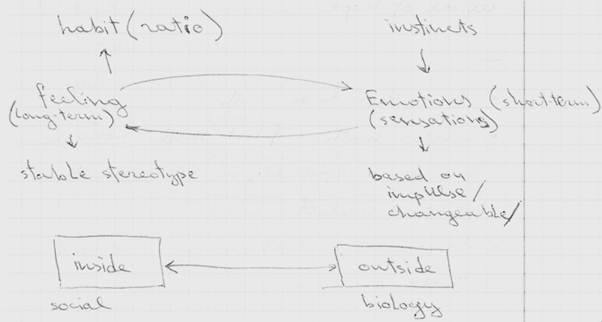
Despite its importance, there is an incredible amount of confusion about feelings and emotions in both the minds of the public and the attention of the «experts». «Emotion» is the general term which encompasses the feeling tone, the biophysiological state, and even the chemical changes we are beginning to understand underline the sensations we experience; «feeling» is our subjective awareness of our own emotional state. It is that which we experience; that which we know about our current emotional condition.
Feelings, particularly the complex and subtle range of feelings in human beings, are testament to our capacity for choice and learning. Feelings are the instruments of rationality, not as some – would have it – alternatives to it. Because we are intelligent creatures, we are capable of, and dependent on, using rational choice to decide our futures. Feelings become guides to that choice. We are just passive responders, as some lower life forms are, to that which the environment offers us. We can avoid certain conditions, select out others, and anticipate both and, moreover, via anticipate can even modify the nature of the environment. Feelings are fine tunings directing the ways in which we will meet and manipulate our environment.
Feelings of anxiety, boredom, tension and agitation alert us the sense of something wrong, and, more importantly, by the subtle distinctions of their messages they indicate something of the nature of the impending danger and direct us to specific kinds of adaptive maneuvers to avoid, prevent, or change the incipient threat. Feelings of guilt allow us to model our behaviour against certain ideals and register when we have moved away from these ideals, or have not yet achieved them. If there is a common ingredient to the various sources and forms of pleasure, the only one that can be identified is that they all seem to contribute to an enhanced sense of self Pleasurable events either intensify our sense of ourselves or enlarge our view of ourselves. Joy stems from an altered sense of self and, in turn, alters our view of our world and the way we are viewed.
1. Answer the following questions:
1. How do you understand the statement «it is the feeling that counts»?
2. Why is it difficult to classify sensations and what terms are suggested in this article?
3. How does «emotion» differ from «feeling»?
4. Do you agree that feelings are «the instruments of rationality, not alternatives to it»?
5. How do feelings of anxiety, boredom, tension and agitation serve adoptive purposes?
6. Of what importance are feelings of guilt?
7. What do the positive feelings have in common?
8. How do pleasurable events affect our feelings?
How do emotions differ from feelings
Feelings and emotions are two important components of our soul (character) and our life.
Emotions are the general term which include the biophysiological state and chemical changes in our body. They are subjective reactions of people on the effects of internal and external irritants shown in the form of pleasure or displeasure, joy, fear and etc.
Feelings are our subjective awareness of our emotional state. It is that what we experience, our current emotional condition. Feelings are the tool of rationality.
Текст из учебника
One day you feel good and the next you feel bad, and between those two poles are compressed all the joys of heaven and the anguish of hell. The events that prompt feelings, the justification for the feelings, even the reality of the perceptions that lead to them are all unimportant. It is the feeling that counts.
Despite its importance, there is an incredible amount of confusion about feelings and emotions in both the minds of the public and the attention of the “experts». «Emotion» is the general term, which encompasses the feeling tone, the biophysiological state, and even the chemical changes we are beginning to understand underline the sensations we experience; «feeling» is our subjective awareness of our own emotional state. It is that which we experience; that which we know about our current emotional condition.
Feelings, particularly the complex and subtle range of feelings in human beings, are testament to our capacity for choice and learning. Feelings are the instruments of rationality, not — as some would have it — alternatives to it. Because we are intelligent creatures, we are capable of, and dependent on, using rational choice to decide our futures. Feelings become guides to that choice. We are not just passive responders, as some lower life forms are, to that which the environment offers-us. We can avoid certain conditions, select out others, and anticipate both and, moreover, via anticipation we can even modify the nature of the environment. Feelings are fine tunings directing the ways in which we will meet and manipulate our environment.
Feelings of anxiety, boredom, tension and agitation alert us to the sense of something wrong, and, more importantly, by the subtle distinctions of they messages they indicate something of the nature of the impending danger and direct us to specific kinds of adaptive manoeuvres to avoid, prevent, or change the incipient threat Feel- ings of guilt allow us to model our behaviour against certain ideals and register when we have moved away from these ideals, or have not yet achieved them. If there is a common ingredient to the various sources and forms of pleasure, the only one that can be identified is that they all seem to contribute to an enhances sense of self.
Pleasurable events either intensify our sense of ourselves or enlarge our view of ourselves. Jоv stems from an altered sense of self and, in turn, alters our view oil our world and the way we are viewed.
это мысль, которая имеет значение
Аналог в русском языке: важен не подарок, а внимание
Hello and welcome to The English We Speak. I’m Feifei.
Здравствуйте и добро пожаловать в программу «Английский язык, на котором мы говорим». Я Фейфей.
Oh what’s that parcel you’ve got in your hands there, Neil? Looks exciting…
А что это за пакет там у тебя в руках, Нил? Выглядит интригующе…
A present? For who?
Подарок? Для кого?
For you! For Christmas!
Для тебя! На Рождество!
Christmas? It’s a bit early, isn’t it?
Рождество? Несколько рановато, не так ли?
Well, I saw these and I just knew you’d love them so much – so I bought them! I can’t wait till Christmas to see your face. Go on, open it now!
Ну, я увидел его и понял, что он тебе очень-очень понравится, поэтому и купил его! Я не могу дождаться Рождества, чтобы увидеть твое лицо. Давай, открой его сейчас!
You’re too kind, Neil. OK… A pair of glasses… Harry Potter glasses.
Ты такой заботливый, Нил. Хорошо… Очки… Очки Гарри Поттера.
Aren’t they brilliant?! Go on, try them on.
Разве они не замечательные?! Давай, примерь их.
I look ridiculous. And I don’t even like Harry Potter. Oh well, it’s the thought that counts.
Я выгляжу нелепо. И мне совсем не нравится Гарри Поттер. Ну что ж, важен не подарок, а внимание (it’s the thought that counts).
‘It’s the thought that counts’. An excellent expression, Feifei. If someone gives you a present which you don’t like, you can say ‘it’s the thought that counts’.
It’s a polite way of saying you appreciate the effort and the kind thought a person had when they bought you a present – but you don’t like what they bought.
Let’s hear some examples of this expression which is particularly useful around Christmas time.
Давай послушаем несколько примеров этого выражения, которое особенно полезно во время Рождества.
This is The English We Speak from BBC Learning English. Our expression is ‘it’s the thought that counts.’ It means the kindness someone shows when they buy you a present is more important than the gift itself.
Это программа «Английский язык, на котором мы говорим». Наше сегодняшнее выражение «it’s the thought that counts«. Оно означает, что забота, которую кто-то проявляет, покупая вам подарок, важнее самого подарка.
A very useful expression for politely saying that a present someone bought you is really not what you wanted. OK, Feifei, lean over.
Очень полезное выражение для того, чтобы вежливо сказать, что подарок, который кто-то купил вам, на самом деле не то, что вы хотели. Так, Фейфей, наклонись.
Ouch! What are you doing with that pencil?
Ой! Что ты там делаешь карандашом?
Hmm I need a spell to make you vanish, Neil…
Хм, мне нужно заклинание, чтобы заставить тебя исчезнуть, Нил…
It’s the thought that counts
Смотреть что такое «It’s the thought that counts» в других словарях:
It’s the Thought That Counts — Infobox Album Name = It s the Thought That Counts Type = ep Longtype = Artist = Jill Sobule Released = 2001 Recorded = Genre = Length = Label = Producer = Reviews = Last album = This album = Next album = It s the Thought That Counts is an EP… … Wikipedia
it’s the thought that counts — it’s the thought that counts phrase used for saying that caring about someone is more important than spending a lot of money on them Thesaurus: presents and giftssynonym Main entry: thought * * * informal used to indicate that it is the kindness… … Useful english dictionary
it’s the intention that counts — it is the thought that counts, the good intention of a person is more important than the actual results of their actions … English contemporary dictionary
it’s the thought that counts — used for saying that caring about someone is more important than spending a lot of money on them … English dictionary
The Big Comfy Couch — Format Children s television series/Educational Created by Cheryl Wagner Starring Alyson Court … Wikipedia
The Queen’s Book of the Red Cross — was published in November 1939 in a fundraising effort to aid the Red Cross during World War II.The book was sponsored by Queen Elizabeth, and itscontents were contributed by fifty British authors and artists.List of authors and artists*Authors… … Wikipedia
thought — thought1 [θo:t US θo:t] the past tense and past participle of ↑think 1 thought 2 thought2 W1S1 n ▬▬▬▬▬▬▬ 1¦(something you think about)¦ 2¦(ideas/opinions)¦ 3¦(careful consideration)¦ 4¦(act of thinking)¦ 5¦(caring about something)¦ 6¦(intention)¦ … Dictionary of contemporary English
thought — 1 past tense and past participle of think 1 2 noun 1 STH YOU THINK ABOUT (C) something that you think of, remember, or realize; idea: I was just going to pick up the phone when a sudden thought made me hesitate. (+ of): a traveller s thoughts of… … Longman dictionary of contemporary English
thought — thought1 [ θɔt ] noun *** ▸ 1 idea etc. entering mind ▸ 2 mental effort ▸ 3 idea/opinion ▸ 4 plan/wish to do something ▸ 5 care/worry ▸ 6 system of ideas ▸ + PHRASES 1. ) count a word, idea, or image that comes into your mind: a… … Usage of the words and phrases in modern English
thought — I UK [θɔːt] / US [θɔt] noun Word forms thought : singular thought plural thoughts *** 1) [countable] a word, idea, or image that comes into your mind a comforting/sobering/chilling thought thought of: His mind was filled with thoughts of revenge … English dictionary