The number of items that can be minted no gas cost to you
The number of items that can be minted no gas cost to you
Why OpenSea?
Lazy Minting, No Gas Fees, Unlockable Contents
 T he first step for publishing an NFT-artwork is: to find a place to showcase them. And the journey of trial&error begins. Because there are no how-to’s (or better: there are too many how-to’s to orient within this chaos).
My first platform was Rarible (just because everybody told about it [take care on things everybody is talking about]). I already had prepared several Digital Artworks, I created my profile, I uploaded my artwork, and then… rude awakening. Called “ gas fees”. Welcome to the CryptoCapitalism. Gas Fees are payments for specific computational effort for specific calculations of transactions in Ethereum (initial minting, listing, transfer, speeding up etc.).
And they are expensive. Especially if you just begin your NTF journey. Here are some numbers.
Paying these fees doesn’t guarantee you any ROI. And you have to pay gas for almost every (trans)action with your NFT.
So shocking revelations may follow:
Using https://fees.wtf/ you can see, how much gas fees have you paid (if you want to see it at all).
Additionally (or, forward-looking: predominantly) every transaction, every “gas” in Bitcoin or Ethereum means horrendous environmental costs:
#Cryptoart and #NFT: Addressing environmental issues
My series about #NFTart
To be honest, for me all that was almost the reason to stop exploring the NFT scene. Until I’ve got good advice:
This is supported by several platforms, and hard-boiled NFT-artists are sometimes opposite to this (they jump into the abyss by learning to fly, instead). “Lazy minting” means showcasing your NFT-art passively, waiting for others discovering you. Of course, you can undertake the marketing and distribution of your artworks. But until somebody will found you, your works will remain undiscovered.
OpenSea
OpenSea is one such platform. And diving deeper into it I decided in favor of this system. It provides even more interesting features:
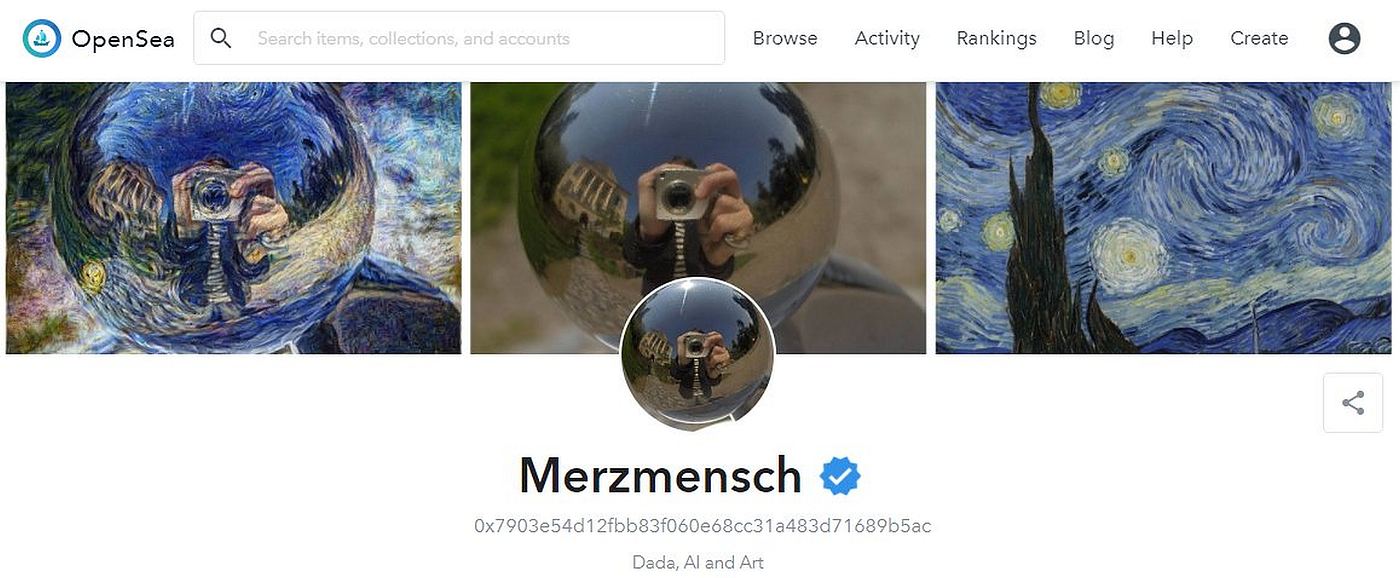
This, and many other aspects were vital for my choice of NTF platform. Here is my profile btw.:
How to Mint Your First NFT on OpenSea? A Step-by-Step Guide
Last Updated Dec 29, 2021 @ 17:02
Minting NFTs might sound quite complicating and for beginners – it might be. Here’s a comprehensive, step-by-step guide on how to mint your first NFT using the OpenSea NFT marketplace.
Quick Navigation
Unlike standard tokens, NFTs are non-interchangeable. They serve as digital representations of items, such as artworks, images, videos, or anything that can be tokenized.
We’ve seen brands of all kinds, from fashion to sports, and even real estate companies jumping on the NFT bandwagon. Just recently, Nike acquired NFT collectibles RTFK as part of its digital transformation. Just like Nike, RTFK produces shoes, but digitally.
What is NFT Minting?
Minting is the process of tokenizing a digital file with cryptography. Tokenization is the process of turning an asset into a digital token that can be moved, stored, and recorded on the blockchain.
Anybody can easily mint an NFT. But while there are many NFT marketplaces where you can start minting, we’ll focus on the largest decentralized platform for NFT collectors and artists – the OpenSea marketplace.
How to Make Money Selling Your NFT on OpenSea?
OpenSea is an NFT marketplace where sellers are connected to potential buyers on the other side. There are currently millions of NFTs up for sale on the marketplace. However, don’t be left with the wrong impressions – the huge demand created an even higher supply.
Millions of NFTs are desperately waiting for a buyer that will never come.
So, if you are here “only for the money,” you better think twice, or instead, better think deeper how to position yourself in this fast-emerging industry.
So before we start, it’s important to note that the below won’t teach you how to make money from your NFTs. It will guide you to mint your first NFT and place it for sale on OpenSea in a step-by-step way that anyone can easily do.
How to Mint Your First NFT on OpenSea?
NFTs are unique digital assets issued and are stored on the blockchain. To start minting NFTs, you need a wallet that can be connected to OpenSea. There are a few options here, but we’ll recommend and use MetaMask as it’s the most popular one.
First of all, you’ll have to link your MetaMask wallet to the OpenSea marketplace. MetaMask is a wallet available both as cold storage (when integrated with a physical HD wallet like Trezor or Ledger) and as a browser extension for Google, Chrome, and Brave. If you don’t have it, go to metamask.io and download it for your browser. Next, add it as an extension – you’ll see a tiny orange fox on the upper right side of your browser.
Important: in case you install the wallet for the first time, beware of phishing attempts and double-check you visit the correct website URL, read here for more security tips.
Once installed, you can easily access it anytime you want to check your balance or send and receive funds.
On MetaMask, you can store ERC-20 tokens such as Ether (ETH) – the currency you’ll likely be using to buy and sell NFTs on OpenSea.
In addition, you receive royalties in ETH, too: when someone buys an NFT from you and resells it, you receive a percentage of that sale, and it goes to your MetaMask address.
Beware: there are more security risks when using web wallets if they are not integrated with hardware wallets. So far, MetaMask hasn’t suffered any major hacks, but users should be wary about ongoing phishing attacks and related scams.
This is why it’s always advisable to use a hardware wallet. MetaMask supports the two most popular HD brands – Trezor and Ledger.
Before we start, you need to have some ETH in your wallet to pay transaction fees. As mentioned, ETH is the base currency, and it’s used to pay fees for every transaction and confirmation on OpenSea using MetaMask.
Connecting MetaMask
First, go to opensea.io and navigate the top right bar – click on Profile. A new page will appear, prompting you to connect your wallet. Choose MetaMask.
You’ll go to multiple prompts for granting OpenSea the necessary permissions to use your wallet and funds. Next, a signing request will appear, and following the signing in, a “Connecting” screen will pop, which will link OpenSea to your wallet.
Proceed by accepting the Terms & Conditions. You can easily access your funds in the wallet icon at the top right corner.
If your wallet is empty, just click on “Add Funds.” From here, you can either make a crypto deposit or buy using a debit/credit card.
Easy, right? Now you have to create your first collection on OpenSea.
Creating an NFT Collection
Now that your account is ready to process transactions on the Ethereum blockchain, it’s time to build your first NFT collection.
Go to your profile and select “My Collection,” hit “Create” to start a new one. Your new collection will be composed of the logo image, the featured image, and the banner.
Below you’ll find different properties to fill in, starting with the URL of your collection on OpenSea, the description, category, and links to your website and social networks.
You will be asked to insert your payout wallet address. Go to the wallet icon and click on your address, it will automatically copy it, then paste it on the required field.
New items will be stored on the blockchain of your choosing, in this case, we’ll use Ethereum, but you can also choose Polygon. This is a sidechain, a Layer-2 blockchain that takes off workload from Layer-1 blockchains such as Ethereum and executes them separately, resulting in higher throughput and lower gas fees.
Next, choose the payment tokens to buy and sell your items. After you’re done, click “Create.”
Your collection is now set! Now you have to add some items to it – which is the actual minting process.
Minting your NFTs on OpenSea
The process is straightforward. The AI will take care of all the technical aspects of it, so don’t worry about how it’s actually minted.
4. Next, choose the collection in which your NFT will appear, which in our example, we chose the sample collection we made earlier.
Fill in the properties of your NFT, like the eyes, color, ticker symbol, the artist name, etc.
5. Fill in the levels. For example, your NFT has a 5/10 strength or speed level.
6. Add some stats to your NFT. These are numerical traits that show as numbers.
7. Choose whether it’s unlockable content and explicit or sensitive content. This means that someone might win the special contents hidden in an NFT. For example, you might set up a lottery in your NFT and put the winner hidden in unlockable content.
8. Finally, choose the supply, which is the number of copies that can be minted, and the issuing blockchain.
9. Click on “Create” and your new item will appear as a new NFT in your collection. You are free to offer it for sale at a set price or to the highest bidder.
It’s important to keep in mind that OpenSea’s revenue-generating model is relatively simple but taxing. The platform takes 2.5% of every transaction that happens on it.
Closing Words
As you see, minting on OpenSea isn’t as hard as most people think it is. You just need your digital wallet set up, connect it to the platform, and start creating your collection. The process is similar to other marketplaces – you just have to check out what marketplace suits you best.
Opensea Minting Fee | How Much Does it Cost to Mint an NFT on Opensea
What Does Minting NFT Mean? What does minting an NFT mean? Buying a product before it sells out. Our buy any product.
Your support allows us to provide usefull info to businesses like you. Your TINY contribution helps keep us ALIVE. #Thanks
What Does Minting NFT Mean?
What does minting an NFT mean? Buying a product before it sells out. Our buy any product with early access from platform A and then sell the same product on platform B at a higher price is called NFT Minting. You can replace the word “Product” with NFT. Some platforms are charging a commission to sell products on their platform; this commission is called a Gas fee in the NFT world.
If you get any value out of this article. All I ask is that you please donate us any amount and appreciate our work. Platforms like us run on your donations. Your support allows us to provide useful info to businesses like you. Your TINY contribution helps keep us ALIVE.
How To Mint NFT On Opensea For Free – No Minting Cost
This section will cover how to mint an NFT on the Opensea for free with zero gas fees. So before we begin, we want to make sure that our account is linked with our Metamask wallets. If you have linked your Metamask wallet, then let’s go ahead and get started with creating new collections.
Remember, we’ve created 100 of these, and let’s sell them for, let’s say, 32 cents; now open see is still going to take a 2.5% fee, but there are zero gas fees that you normally would get with Aetherium.
So that’s the upside of using the Polygon Network that you don’t get those expensive gas fees. So let’s go ahead and click on the complete listing, and to complete your listing, it’s going to ask you to unlock a currency, so all we have to do is open up our meta mask notification here click sign now we have to sign a message with our wallets.
So let’s click on sign again. And now we have listed our basic Sun Moon. So if we go to our sun moons collection here, we can see that we have our Sun Moon, and of course, we are selling it for 32 cents. So that is basically how you can mint an NFT on Opensea with zero gas fees.
If you liked this article and it helped you out, please donate us 2USD.
Minting fee of NFT marketplace for selling an NFT
How Much Does it Cost to Mint an NFT on Opensea
As the world of non-fungible tokens (NFTs) evolves, more artists and innovators are flocking to the sector in the hopes of reaching a larger audience. NFTs, give talented people the opportunity to give their work the exposure it deserves while also establishing ownership, provenance, and royalties.
On the other hand, getting artwork or a collectible on the blockchain necessitates the creation of a token. While this process is becoming more straightforward, hidden expenses may catch some people off guard.
| Rarible | |
| 1+ NFT lazy minting | Free / 5% of final value fee |
| 1+ on-chain mint | $55-$200 + 5% final value fee |
| Approval | $10-$30 |
So, how are NFTs minted, and how much does it cost to mint an NFT? We’ll look at a few of the most popular platforms and examine the procedure and fees involved.
Cost of minting NFT in 2022
On the other hand, Mint prices are a factor that many people overlook. These are the costs associated with transacting on the Ethereum blockchain.
A Mint fee is a charge for the energy used in processing any NFTs transaction. Because of the amount of energy necessary to transfer and validate transactions on the blockchain, the gas fee is one of the key issues that NTFS faces. Gas prices are frequently exorbitant, to the point where the gas fee of a transaction may be greater than the actual price of the NFT. The price of a gas transaction varies according to the time of day and network traffic at the time of transaction.
A significant amount of CPU power is required whenever something is written or changed to the Ethereum blockchain’s digital ledger. Gas fees are a means for the network to reward the “miners” that help with the cryptographic legwork. The user is usually responsible for this.
A gas price is usually involved during minting because a smart contract is written to the blockchain. Minting at quieter periods of the day and week when the network is quieter can lower rates. Early Sunday mornings are typically the quietest, as miners’ computational power isn’t as demanded.
Gas costs can also be reduced by employing blockchains like Binance, which are designed to reduce costs and increase the speed at the expense of centralization.
The marketplace charges a fee for listing an NFT item on their site. Opensea, the largest NFTs marketplace, allows producers to sell their things for free in exchange for a 2.5 percent commission on each item sold. Rarible, like Opensea, charges a service fee of 2.5 percent of the item sold, Nifty Gateway takes 5%, and 30 cents of every secondary sale, and SuperRare takes 3% of all fees paid by NFT purchasers.
Why Ethereum Minting fees are so expensive?

As previously stated, the bigger the demand and popularity, the higher the gas fee. Ethereum is one of the most widely used blockchain networks for NFT minting and cryptocurrency transactions. The graph below depicts how Ethereum gas fees have changed over the last three years.
Lazy vs Gasless: How gas-free is gas-free minting?

If you want to mint an NFT on Ethereum without paying gas fees, there are a few ways to do so. Here’s a comparison between the gasless minting feature on Mintable, and lazy minting on OpenSea.
Gas wars that lead to high transaction fees are a big deterrent for both new and experienced creators, while the many different types of minting can be confusing and difficult to navigate.
Why does gas cost so much?

In a nutshell, there are two main categories for minting: with gas or without gas (gas-free minting).
Traditionally, minting an NFT meant you had to exchange the computing resources of miners on the blockchain for a fee in order to process your transaction – this is where the cost of gas comes from. The more computing power required, or the higher the volume of transactions on the blockchain, the higher the gas fees. So people used to wait to raise transactions at a time where there is less activity on the blockchain. This meant waiting till the wee hours of the night just to mint an NFT with the lowest possible fee. On top of pricey gas fees, minting traditionally is a cost to the environment as well.
But with NFTs being rapidly integrated into the mainstream, and with the number of concerns regarding the price and environmental impact of blockchain transactions exacerbated, many marketplaces have introduced ways to mint with minimal cost to creators and the environment.
Today, gas-free solutions for minting an NFT are available on some NFT platforms as a way for both beginner and experienced creators to make the most out of their creations. It helps lower the barrier to entry and increases revenue to the seller when the work gets sold.
Read more about gas fees here.
How gas-free can gas-free get?
Gas-free minting solutions come in a number of ways. Mintable has its own form of gas-free minting called gasless minting, while one of the more common ways of making gas-free transactions is through a process called lazy minting.
Lazy minting:

Lazy minting essentially allows the creator to create NFTs without having to pay gas-fees upfront, the person who buys the NFT will then mint and pay the gas fees at a later time. Lazy minting is essentially a deferred transaction. What happens is your data is stored on a centralised website and the person who buys it pays to mint it – the gas fee is moved to the buyer.
Your NFT is listed on the marketplace as a digital item, but only becomes written on the blockchain when it gets sold. While this provides a solution to the problem of gas fees, it is only temporary and not entirely emission-free. Until someone buys your NFT, it doesn’t actually exist on the blockchain, nor can you find it on Etherscan. You will not be able to find your NFT in your wallet, and it only exists on the marketplace servers. This is because your NFT doesn’t exist until it’s been bought and gas fees have been paid for.
Mintable’s gasless minting:
With Mintable’s gasless minting, you are able to mint your NFTs, without incurring a transaction in the process either. Just like lazy minting, it lowers the barrier to entry and removes the friction of needing to pay to mint an NFT. However, the difference is that the token you mint will be immediately found on the Ethereum blockchain – safe and decentralized.
Creators can manually add their unique item to their wallet (depending on the wallet) to view at no extra cost at all. This empowers creators to focus on honing in their craft without having to worry about the cost of gas. Mintable’s gasless is also hassle-free and emission-free on both ends of the transaction, meaning neither the seller nor the buyer has to worry about the impact minting will cost to the environment.
Because the minted NFT can immediately be found on-chain and on the Ethereum mainnet, the person buying the NFT does not have to go through the process of minting it for themselves upon purchase – both seller and buyer can remain worry-free about their impact on the planet.
Layer 2 for sustainability
 source: coinmarketcap
With Mintable’s up and coming integration with Immutable X (IMX), a layer-2 solution for the Ethereum network and NFT marketplaces, cost of minting will be further reduced. IMX allows for transactions to be made off-chain, with improved speeds and cost, while building on an already robust layer 1 network that is Ethereum. With IMX, creators and buyers will be able to enjoy instant trades on carbon-neutral NFTs, larger scalability, and gas free transactions.
The choice of gas free minting
When it comes to gas free minting, there are no right or wrong answers – it all depends on your preference and what you would like to achieve out of your creation. For creators, turning your artworks into valuable NFTs should be an exciting experience, so have fun with it! Experiment and try different methods of minting with gas as well as without, and make the most of what platforms have to offer. For buyers who are concerned with the environment and the impact of purchasing NFTs, shopping for gas free NFTs are a good way to engage your interests and hobbies of collecting and trading with lessened worry.
Introduction
In this blog, you’ll learn how to use OpenSea like a pro.
Keep in mind, this is not financial advice, and you should never spend money you can’t afford to lose on NFTs. This is meant to give you the tools to discover NFT projects and answer questions about the NFT projects you’ve discovered.
If you do have extra money that you can afford to lose, consider signing up for Coinbase and purchasing some Ethereum so that you can buy NFTs. You can check out our full how-to guide to buying and selling an NFT here if you are having trouble, but we personally use Coinbase and trust the platform. And it’s the first step you need to take before buying an NFT.
Hardware wallets like the Ledger S or Nano X are the most effective ways to protect your NFT assets from scams. The links to the Ledger product suite are affiliate links and we may receive a small commission if you choose to make a purchase. You can read my full affiliate disclaimer disclosure here.
If you want to protect yourself and your NFTs from scams and hacks, you can shop for Ledger Hardware wallets by clicking here.
Disclaimer: I had never heard of Midnight Breeze NFT before writing this article, nor have I had any contact with the creator. I do not own any Midnight Breeze NFTs, or any other NFTs released by the creator.
For this Opensea tutorial, I stumbled upon the project and used the project to show you how to use OpenSea’s Sorting, Filtering & other important functions.
If you need help finding NFT projects to dig into, check out WenAlphaText, a product we built to solve our own problem. The tool lets you track up to 3 NFT wallets and receive a real-time text alert when they purchase an NFT.
Let’s dive in and learn how to use OpenSea like a pro.
How To Use OpenSea Rankings
To get a feel for what NFTs are popular right now, you can go to the Stats Page and look at the Rankings:

They will be sorted based on Volume: High to Low in whatever time period you choose.
The time period of data
Category of NFT Projects
Trading Volume in the time period you choose
Volume percentage change in last 24 hours
Volume percentage change in last 7 days
Lowest Price you can buy an NFT in that Collection right now
Number of unique wallets holding at least 1 NFT in the Collection
Unique Items in NFT Collection
You can click any of these to filter and find what you’re looking for.
You can scroll down to the bottom of the page and look through hundreds of pages of these stats to find what you’re looking for.
I tend to filter Volume by All Time (1 in the image above) and scroll through a few pages to find projects that aren’t super popular right now.
There’s a lot you’ll have to do to gain confidence in an NFT Project. A lot of it is outside of OpenSea, like scrolling through the project’s Discord group, finding their Twitter, discovering who is behind the team, and researching their business success in the past.
A lot of this info is linked on OpenSea, as we’ll see later in this tutorial.
How To Use The OpenSea Explore Page
The Explore Tab is a great place for discovering NFT projects based on the category the NFTs fall under. The variety of all the NFTs you’ll see makes it easy to fall into a rabbit hole and you might just find a project you fall in love with.
The Explore tab is organized into different topics as seen below:

On your computer, click any topic that sticks out to you. I decided to click the Art section, because I’m looking for some artwork to use in a virtual display for a wall or desk at home.
Once you see a project that interests you, click it and you’ll be taken to NFT projects that are trending now. Trending NFT projects on OpenSea are based on recent sales, likes, and views on OpenSea.
You may have heard of NFTs being from a Project or Collection. The terms mean the same thing. Most NFT Marketplaces like OpenSea call them Collections.
Similar to how Authors organize their individual stories into books, most NFTs are organized into Collections. Each Collection is a unique project made by an artist or company.
When scrolling through Trending Collections, you can see a few details about each project. There’s a Collection thumbnail, Collection title, Creator, and description of the collection:

Scroll through and see if there are any names or projects you recognize!
When a project catches my eye, I’ll right-click and open it in a new tab so I can quickly go back to the Trending page where I left off:

How To Use OpenSea Collection Page

What do the Opensea NFT Page Metrics Mean?
Items = Number of unique NFTs in Collection
Owners = Number of unique holders
Floor Price = Cheapest NFT listed for sale in Collection
Volume Traded = Secondary Market Sales since the Collection was created, measured in ETH
We can learn a few things by looking at these 4 stats.
Some Collections have a large supply of 1 of 1 items, each with unique Properties (more about Properties later). Other Collections, like Curio Cards, have a small number of unique NFTs, each with a supply of 100–2000. This is similar to the many unique versions of Basketball trading cards with differing supplies of each.
Since the number of Items in the Midnight Breeze Collection is 7,000, we can assume all the NFTs in the Collection are unique 1 of 1s.
In the NFT world, collectors usually like to see as many Owners as possible. More Owners usually mean the project is stronger because there are more individuals supporting the project vs a few buyers who hold the majority of the supply.
If a few people own most of the supply, they have more control over the market and may be able to drop the price of the project by selling many NFTs at once, overpowering buyer demand.
It’s generally good to see the number of Owners to be at least 50% of the number of items.
For example, if there were 7,000 Items and 50 Owners, it means either 50 Owners own all 7,000, or not all 7,000 have been sold out. You could tell by looking at the Volume and doing the math on how many have been sold.
There’s no one size fits all ratio of Owners to Items to determine a ‘good’ project, but with this example, it’s good to know the NFTs are well distributed among a few thousand wallets. You can also use Etherscan to figure out the biggest holders of an NFT project as well as the distribution. You can read about that here.
Floor Price will tell you right away if you can afford the NFTs in the Collection, as this is the cheapest price they’re listed for right now.
When you scroll down on the NFT Collection, you’ll see NFTs the artist decided to create specifically for the Collection. Similar to how every website is made for a specific reason, each NFT Collection is made for a reason. To see the Collection’s purpose, read the Collection Description.
From here, you can do a lot of filtering to dig deep into the project’s individual NFTs. Your strategy will likely be different than mine as you come up with your own questions and criteria to judge a project on, but if you need a place to get started, this data will help.
First, navigate to the Collection’s Activity page:
How To Use OpenSea Collection Activity

The Activity page can tell you a lot about the project’s market.
The graph shows volume bars, indicating how many items were bought and sold that day, along with the average price.
Take this information with a grain of salt, because some NFTs are rarer than others. Rare NFTs sell for more than Floor Price NFTs, influencing the average price sold for the day. Rare NFTs selling for more can be a good sign because people are willing to put more money into the project than buying a lower-priced asset.
Rare NFTs selling for more isn’t enough alone to determine if it’s worth investing.
If you want to put money into a project, your best bet is to click around the project’s website, social media, Discord, find the founding team and look at their track record.
DMing them directly and asking questions is a good way to get a feel for the creators. If the project’s mission and messaging hits home with you and you feel confident in the team, it’s easier to hold onto your asset if the price goes down.
You’ll also want to know how long the project has existed. You can filter the price history chart to All Time to see when the project was first sold on OpenSea:

Most of the time, the date on the far left is when the project was created. In some cases where it took a while to reach the first sale, or if the project was created before the Ethereum ERC-721 token standard, the developers may have had to create a card Wrapper.
A Wrapper is essentially a new code to make the old code compatible with OpenSea’s marketplace. The new code doesn’t replace the old code. You can think of it as a container to put the old NFT in that allows you to move it around in OpenSea by buying, selling, or transferring.
Wrappers are fringe cases and you’ll often be able to find this information in the project’s FAQ on their website or Discord group.
Next, we’ll scroll down on the Activity page and see what’s been happening with the project recently:

We can see there’s been a handful of sales in the last 6 hours. With a total supply of 7,000 NFTs in the Collection, it’s good to see a steady flow of sales. It would be bad if we saw no sales for days or weeks, which would mean there isn’t much demand for the project.
If we were looking at a project with a supply of just 50 assets, we wouldn’t be surprised to see a few days or weeks between sales. There’s no one size fits all criteria you can apply to every project to determine if it’s good. Every project is different and they’ll raise different questions in your mind. This article is meant to give you the tools to come up with and answer your own questions.
Next, I filter to the Highest Last Sale to see the highest anyone has paid for an NFT in this Collection:
How To Filter In OpenSea Collection

We’re now looking at individual NFTs. You can see the NFTs look different and have different serial numbers for the assets, and there’s a heart icon where other OpenSea users can favorite NFTs with their profile.
Let’s take a closer look at Last Sale vs Price, as this can sometimes cause confusion:

Last Sale is showing the last sale of the asset and is displayed in smaller font size, while Price is what the NFT is currently listed for sale as, and is in a larger font size.
Some NFTs, like the one on the right side of the image above, don’t have a price. That’s because the owner doesn’t have it listed for sale right now.
Unlike eBay, where every item you see is listed for sale, not everything on OpenSea is for sale. This is due to the nature of the blockchain. Every NFT on the Ethereum blockchain can be seen on OpenSea and even though the owner hasn’t listed it for sale, any user can submit offers to buy.
This is a benefit for buying and selling NFTs. There’s no time spent filling out descriptions or listing your items for sale. They’re already filled out and available for anyone to make an offer, indicated by Best Offer below (0.08ETH):

But wait, why is that logo pink under Best Offer? This is the logo for Wrapped Ethereum.
Wrapped Ethereum is the same price as Ethereum. Users who use Wrapped Ethereum are able to submit offers on NFTs they like. Wrapping Ethereum is done inside your MetaMask wallet and costs a gas fee paid in Ethereum. When you see a Best Offer like the one in the image above, it doesn’t mean the offer is active right now. It’s the highest a buyer has offered to buy at one point. Offers can be set to expire for any amount of time.
If you have 0.25 Wrapped Ethereum in your wallet, you can submit an unlimited amount of offers for 0.25 Wrapped Ethereum on NFTs. Once an offer is accepted and you no longer have the Wrapped Ethereum in your wallet, the offers expire automatically.
You may see some users submitting hundreds or thousands of offers on their OpenSea account. They are most likely using bots to submit those offers.
You can see all active offers on an item by clicking the NFT, and scrolling down to the Offers section. If there are no offers listed, scroll down to the NFTs activity to see when the offer expired:

Now we will go back to the NFT Collection where we left off filtered based on Highest Last Sale. (These tangents you’ll go down is why I always recommend you open things in a new tab while using OpenSea.)

The highest last sale in this collection is 1.5 Ethereum. That’s about 39x the Floor Price of this Collection. While a large price difference is quite common in the NFT world, let’s look for what might be causing a buyer to spend so much on that particular NFT.
Right-click & open that NFT in a new tab:

How To Find NFT Info On OpenSea
Here, we’re looking at the individual NFT’s information. Now we can dig deeper into the individual NFTs and see what information we can find.
On the left side of the image, we can see the visual representation of the NFT, Description, Properties, Levels, About (the Collection description), and Details (technical details about the creation of the NFT & Collection)

Properties will be one of your go-to places when looking at individual NFTs:

Remember when I said there may be different rarities? This is where the rarities are decided. The Properties for this NFT Collection are ARCHITECTURE, BACKGROUND, CAR, CHARACTER, DECORATION, FOREGROUND, INTERIOR, MIDGROUND, SKY, SKY ELEMENT, STREET.
Under the blue Property tag, you can see what type of Property this one has. For CHARACTER, this specific NFT has Show Down. We can tell this is a rare attribute for this collection, with only 0.95% of the Collection with this Property.
Let’s open the CHARACTER Property in a new tab
How To Filter NFT Properties In OpenSea

Here we see all the NFTs in this collection that have the Show Down CHARACTER property.
Indicated by the number, this page is showing:
There are 66 NFTs in this collection with Show Down CHARACTER property.
They’re sorted Price: Low To High, based on NFTs listed for sale by the owner right now.
We’re looking at the Collection: MidnightBreeze
Filtered on the Show Down CHARACTER Property within MidnightBreeze:

Later in this article, we’ll learn how to filter multiple Properties at once to dig deep and find a very specific NFT.
The NFTs shown here are actively listed for sale and ordered from low to high.
Keep in mind, the Listed Price and what they actually sell for (aka, what they’re worth) may be very different. Sellers saying they want to sell at a certain price is very different from buyers saying they want to buy at a certain price.
Ultimately, buyer activity is the best indicator of the true price, not the Listed Price. Let’s go up to the filter on the top right and click Recently Sold:

With the latest 3 sold coming in at 0.16, 0.041 & 0.099 ETH, these are quite a ways off the 1.5 ETH high point. If the project has been around for a while, the project may have been worth more but is now much lower. That could be a reason for such a change, but we’ve already checked Collection Activity to discover it’s less than 2 weeks old.
We can go back to the details of the 1.5ETH sale and see if there are other rare attributes that add up to make this NFT the holy grail of the project:

Looking back through the % have this trait, there’s not a ton of ultra-low numbers that would cause the NFT to be ultra-rare. And looking back through the 2nd and 3rd highest NFT sale, those NFTs are actually rarer than the highest sale NFT
There is a way to see the total rarity rank of your NFT by using this tool, but unfortunately, this project isn’t on the website yet, so I added up the % have this trait manually and compared it between the 3.
We still haven’t found a concrete reason the NFT is selling for so much. There’s more to investigate. Let’s take a look at who owns the NFT that was bought for 1.5 ETH.
Go back to your tab showing the details of the Highest Last Sold NFT:

Looking on the right side, we can see a few important stats.
Name of NFT Collection
Name of individual NFT
Name of Owner with link to their OpenSea Profile
Number of views NFT has received
Number of favorites
Price History with price chart (This particular NFT has only been sold once)
Before we visit the owner’s profile, do you notice anything interesting about their name?
DutchtideStudios. For those with a keen eye, you’ll remember from the Collection’s description, the creator of the NFT project is called Dutch Tide.
Did the creator of the project decide to buy the most expensive NFT in the collection?
Scrolling down to the Activity on the individual NFT, we can determine if the creator made an offer to buy it at that price, or if the original buyer listed it for sale at that price:

We can see right away that it was DutchtideStudios that initiated the offers, first offering 1 ETH, then offering 1.5ETH a day later.
This is an interesting move by the creator. It’s hard to tell why they would do this.
Are they artificially inflating the highest sold price to entice more buyers into a seemingly strong market? Are they buying a lot of their own NFTs at an artificially high price on purpose? Perhaps that NFT is simply their favorite one and they really wanted to buy it back?
How to use OpenSea’s Collector Page
Let’s attempt to determine the buyer’s intent by clicking on the owner’s profile:

And here’s what the profile looks like:

We’re now looking at an individual collector’s profile. Similar to how most people have their own social media profile page, this is a collector’s OpenSea profile.
It’s good to remain skeptical in the Crypto space when doing research. Can we really prove this is actually the creator of this project, Dutch Studios? Or are they an imposter? The first thing I see is their Twitter profile linked in the description, which doesn’t really prove anything. Any imposter could link a Twitter profile.
I clicked on the Twitter profile, and in a completely baffling discovery, it turns out I follow DutchTide on Twitter, and have been following for a few months now. Because NFTs are such a small community right now, there are a lot of small-world moments in the NFT space and these little moments are so fun.
But that still doesn’t mean this OpenSea profile is the real DutchTide. They’re a supporter of the project, owning a handful of NFTs from the MidnightBreeze collection. And we can use these NFTs to get closer to confirming it’s really MidnightBreeze.
We do have a clue here. Take a look at the serial numbers of these NFTs. A lot of the time, NFTs are issued to buyers in the order they were minted, aka, first bought from the creator’s website. This means the first buyer will get serial number 1, buyer two will get serial number 2, and so on.
We see that this profile owns Serial Number #1. Meaning they either bought on OpenSea or minted the very first one:

How would we know if they were bought on OpenSea or minted the very first NFT in the Collection?
Notice how there’s no ‘Last Sold’ indicator? This means there has been no sales history on OpenSea, and this profile is the original owner, meaning they were there at mint.
If we click on the serial #1 NFT and look at the activity, we can see Dutchtide was the original minter of this NFT:

On Dutchtide’s profile, we can filter based on Oldest. If the original minters truly received their NFTs based on order of mint, we should see the NFTs they own ordered from lowest serial number to highest serial number.

Our theory holds true! They’re ordered 1,5,9,16,17 & so on.
So what exactly have we discovered? It seems like this could be the creator of the MidnightBreeze Collection since they minted the very first NFT in the collection. I think it’s safe to assume the creator would want to mint some of the first NFTs in their Collection if they truly enjoyed the project they made.
While we don’t know exactly why they bought the NFT for 1.5ETH, I think it’s safe to assume the creator isn’t purposely inflating the Highest Last Sold metric, as they didn’t bid on the other top 2 most expensive sales. I think they just loved that particular NFT and wanted to buy it for themselves.
Again, the criteria you look for in a project will vary. What works for me may not work for you, so please don’t take this guide as a complete list of things to look at before buying into a project.
Let’s say I’m happy with the findings involving the creator and their holdings. Maybe I like how certain attributes look and I want to understand how much it would be to buy one of those.
Let’s go back to the MidnightBreeze Collection and look for attributes we like. I would start by scrolling through the NFTs and looking for things that catch my eye:

We’re back at the Collection Items page. Before we move on, take a look at the bottom left Item.
This is an item that’s not listed for sale by the owner but has an active offer to buy. You’ll see this kind of thing pop up a lot when on the Collection Item page.
Remember, if the Ethereum Logo in the largest font size is Pink and says ‘Top Bid’ on it, that item has an active bid and is not listed for sale. If the Ethereum logo is Black and says ‘Price’ on it, that item is listed and you can buy it now.
How To Filter Multiple Properties at Once On OpenSea
So, we’re looking for Properties we want our NFT to have. I want mine to have a White Sun, an Orange Sky, and an Ayota Cyan car.
Let’s try and find an NFT with all these attributes.
On the left side of the Collection Items page, you can see a filtering mechanic. This drop-down menu has all of the Properties within the Collection, and we can filter based on all of these.