What is a difference between the functions of cloud computing and virtualization
What is a difference between the functions of cloud computing and virtualization
What’s the Difference Between Cloud and Virtualization?
By Tobias Geisler Mesevage
If you think of cloud computing and virtualization as being interchangeable, you are not alone. You aren’t correct, but you are certainly not alone.
Forrester Research found that 70% of what IT administrators call “private clouds” don’t actually fit the definition of cloud computing.
The confusion is understandable when you break down each term and learn that the cloud has more in common with virtualization technology than it does differences.
In this article, we break down the basics of cloud computing and virtualization technology and the benefits of each.
What Is Cloud Computing?
The National Institute of Standards defines cloud computing as “enabling ubiquitous, convenient, on-demand network access to a shared pool of configurable computing resources (e.g., networks, servers, storage, applications, and services).”
To be a cloud, NIST has determined it must have the following five essential characteristics:
Without those five essential characteristics, it is technically not a cloud.
The cloud model is comprised of three service models:
There are four deployment models of the cloud:
What Is Virtualization?
Contrary to what some believe, virtualization is not cloud computing. It is, however, a fundamental technology that makes cloud computing work. While cloud computing and virtualization rely on similar models and principles, they are intrinsically different.
Simply put, virtualization can make one resource act like many, while cloud computing lets different users access a single pool of resources.
With virtualization, a single physical server can become multiple virtual machines, which are essentially isolated pieces of hardware with plenty of processing, memory, storage, and network capacity.
Each virtual machine can run independently while sharing the resources of a single host machine because they’ve been loaded into hypervisors. Hypervisors, also known as the abstraction layer, are used to separate physical resources from their virtual environments. Once resources are pooled together, they can be divided across many virtual environments as needed.
Cloud Computing vs. Virtualization
Deciding which to implement for your business depends on the type of business and the requirements you have.
For smaller companies, cloud computing is easier and more cost-effective to implement. Resources are accessed via the Internet rather than added to the network.
Many small businesses are turning to the cloud for applications such as customer relationship management (CRM), hosted voice over IP (VoIP) or off-site storage. The cost of using the cloud is much lower than implementing virtualization. Cloud computing also offers easier installation of applications and hardware, access to software they couldn’t otherwise afford, and the ability to try software before they buy it. It requires a small investment to implement a cloud-based application.
For some businesses, virtualization is the smarter choice and can save money in several different ways:
Related

Dallas MSP Keeps Major Florida Hotel Up and Running After Server Failure
When their luxury hotel client experienced server failure, TekConcierge kept the business running with Datto SIRIS, avoiding downtime and lost profits for the client

What MSPs Should Look for in DRaaS Offerings
Disaster recovery as a service (DRaaS) is a critical offering for managed service providers (MSPs) to support their clients and grow their bottom line.
Want to learn how Datto can help with SIRIS?

Minimizing Business Downtime with a Complete Restore Toolkit
In this eBook, we’re highlighting the tools MSPs need to address disasters and avoid downtime.
Cloud Computing vs Virtualization
By  Priya Pedamkar
Difference Between Cloud Computing vs Virtualization
Cloud Computing is a model for enabling convenient, on-demand network access to a shared pool of configurable computing resources (e.g., networks, servers, storage, applications, and services) that can be rapidly provisioned and released with minimal management effort or service provider interaction. A Virtualization is Software that creates “separated” multiple hardware and software images on the same machine. This makes it possible to install multiple OS, multiple software and multiple applications on the same physical machine. Cloud is good for public use other side IT companies use Virtualization for cost-efficient data center setup.
Cloud Computing
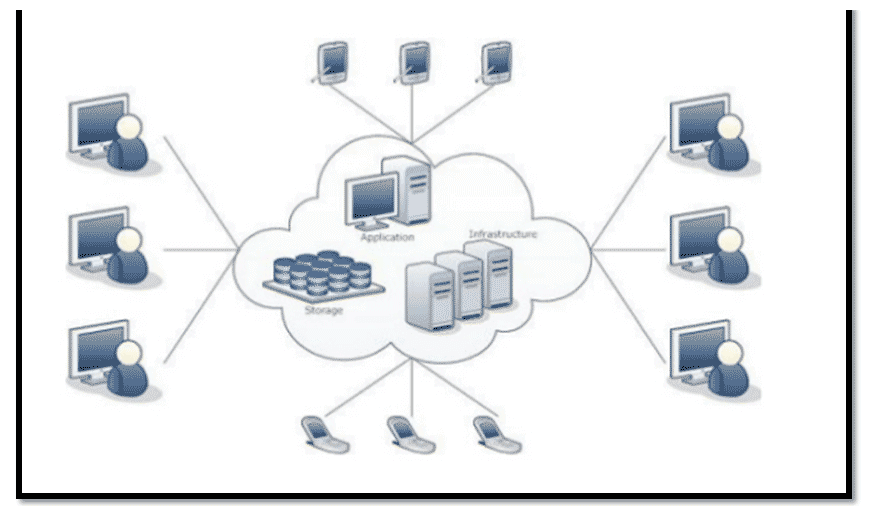
Figure1, Cloud Architecture and it’s layout (Pic Credit)
Hadoop, Data Science, Statistics & others
In Figure 1, Various applications, Storages, and Infrastructure servers are running over the cloud and accessible for all type devices such as Mobile phones, Computers, etc. Cloud can be accessed through the internet depend upon permissions. Cloud is useful for external user access. Amazon Web Services, Google Cloud, Dropbox are the few examples of cloud techniques.
Virtualization
Using virtualization, the software can reduce the cost of hardware and it increases utilization, accessibility, and efficiency of the infrastructure. Virtualization works on the top of the hardware of the physical server and divides its hardware into multiple segments (Virtually only) where virtual machines are then installed.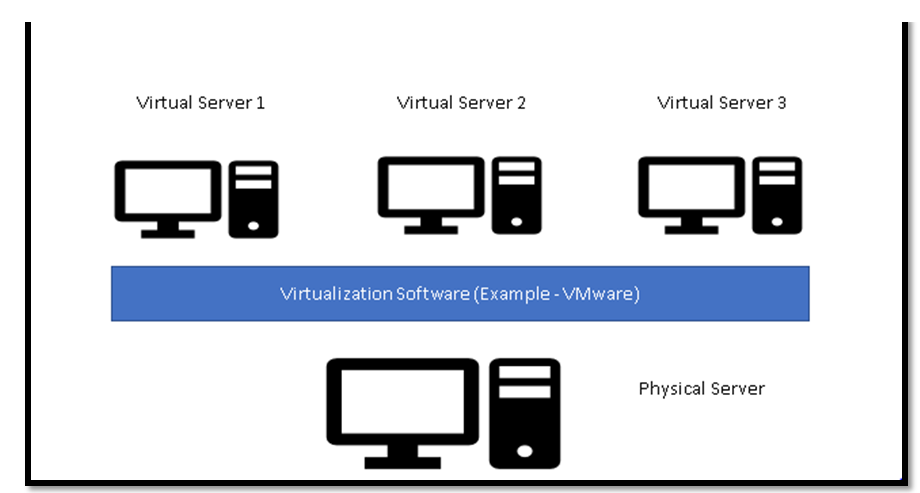
Figure 2, Single Physical Machine divided into multiple virtual machines using Virtualization Software.
In Figure2, VMware software has divided/splits the Physical servers into multiple machines and all the virtual machines reside within the same Physical Server itself.
Benefits of Cloud Computing
It is accessible to all the users (proper credentials) without any restriction.
Using the cloud for applications is cost-efficient.
Least the possibility of access failure due to non-dependency on a single machine.

Cloud provides you independence from machine access. URL will give you access to your infrastructure all the time.
Real-time user access. Multiple users can access the same application and can work on it (Example – Google Doc)
Cloud is reliable for Backup and recovery since data storage is not server-specific.
Cloud computing is the best platform to showcase your applications/software worldwide. Users can access your application & work on it using a single link.
Flexibility to access it from anywhere makes it popular among users and service-providing industries.
Benefits of Virtualization
Server virtualization is the top reason behind its success.
IT industries setting up thousands of servers’ machines using a virtualization technique.
Multiple applications can be installed on a single physical machine despite OS dependency.
The setup cost is very low. Virtualization can be done on a Personal Computer.
The desktop virtualization feature provides flexibility to virtualize the whole system by a single click.
Virtual infrastructure works well with the low-speed network access.
Virtualization has reduced the cost of Hardware in the IT industry because the single server can serve as multiple machines.
Virtualization is Plug & play service; Thousands of machines can be created and make available for use without taking much time. Virtualization software can virtualize the physical servers without taking much time.
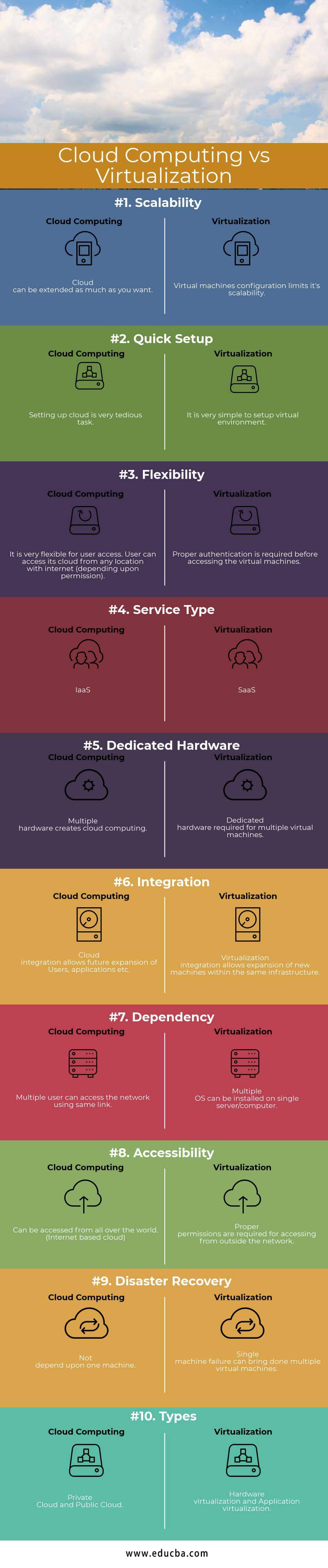
Head to Head Comparison Between Cloud Computing and Virtualization (Infographics)
Below is the Top 10 Comparison Between Cloud Computing and Virtualization:
Key Differences Between Cloud Computing and Virtualization
Below is the difference between Cloud Computing and Virtualization:
The cloud environment is accessible through URL so it can be accessed outside work premises (Depending upon permission).
Cloud Computing and Virtualization Comparison Table
Below is the comparison table between Cloud Computing and Virtualization.
| Key Points | Cloud Computing | Virtualization |
| Cloud can be extended as much as you want. | Virtual machine configuration limits its scalability. | |
| Setting up the cloud is a very tedious task. | It is very simple to set up a virtual environment. | |
| It is very flexible for user access. A user can access its cloud from any location with internet (depending upon permission). | Proper authentication is required before accessing the virtual machines. | |
| Multiple hardware creates a cloud computing | Dedicated hardware required for multiple virtual machines | |
| Cloud integration allows future expansion of Users, applications, etc. | Virtualization integration allows the expansion of new machines within the same infrastructure. | |
| Multiple users can access the network using the same link. | Multiple OS can be installed on a single server/computer | |
| It can be accessed from all over the world. (Internet-based cloud) | Proper permissions are required for accessing from outside the network. | |
| Not depend upon one machine. | Single machine failure can bring done multiple virtual machines. | |
| Private Cloud and Public Cloud | Hardware virtualization and Application virtualization. |
Conclusion
Cloud infrastructure cannot be established without the help of virtualization. It is the foundation of cloud networks. In IT infrastructure, cloud computing and virtualization are used together to build a cloud infrastructure.
Virtualization separates the hardware from the physical machine to create multiple virtual machines on the same server while cloud gets build using multiple virtual infrastructures which combines the multiple virtualized applications/software/servers to create one instance for each application or software or server for users.
Google Docs is the best example of cloud computing
Recommended Articles
This has been a guide to Cloud Computing vs Virtualization. Here we have discussed Cloud Computing vs Virtualization head-to-head comparison, key differences along with infographics and comparison table. You may also look at the following articles to learn more –
Cloud Computing Training (18 Courses, 5+ Projects)
Cloud Computing vs Virtualization: Definitions, Pros and Cons, and Key Differences
Cloud computing and virtualization are the two main approaches organizations encounter when looking to optimize and modernize their IT infrastructure. However, to determine which will be the most suitable choice for your organization, you need to clearly understand how they work and how they differ.
The terms cloud computing and virtualization are often used in conjunction with one another and sometimes even interchangeably. In reality, they are very different concepts, each with its own set of pros and cons and designed to tackle different challenges.
In this article, we overview virtualization and cloud computing, explore their advantages and disadvantages, and summarize their similarities and differences.

Market Research Specialist
Contents:
Are cloud computing and virtualization the same?
Both virtualization and cloud services create environments from abstract resources, which is why these terms are sometimes used interchangeably. Before we explore each of these approaches in detail, let’s briefly outline their major characteristics to understand the basics of how they differ.
The key difference is that virtualization is a technology, while cloud computing is an environment.

Is virtualization necessary for cloud computing? Cloud computing uses server virtualization as an underlying part of the service, helping providers pool and deliver resources. If you already have a virtual infrastructure, you can expand it and turn it into a cloud. To do that, you’ll need to pool virtual resources, orchestrate them, and create a self-service portal for users.
However, while being prominently used as a part of cloud services, virtualization is not necessary for a cloud to exist and is not the equivalent of a cloud environment. Rather, modern cloud services are built on top of virtualization to deliver automation and scalability.
Let’s take a deeper look at these approaches, explore how they work, and discuss their pros and cons.
What is cloud computing?
Cloud computing is a methodology for delivering computer system resources and services like data storage and computing power from clouds on demand. Clouds are pools of virtual resources. They are orchestrated by management and automation software in a way that allows users to access them through self-service portals supported by automatic scaling and dynamic resource allocation.
All services and resources are hosted at a remote data center managed by a cloud services provider (CSP). A CSP provides the requested resources and bills them according to usage. Organizations often adopt cloud computing as part of a strategy to cut costs on maintaining and managing their own IT infrastructure, since they only pay for cloud resources used. This flexibility comes in handy if the required resources vary over time.
Cloud computing is a model for enabling ubiquitous, convenient, on-demand network access to a shared pool of configurable computing resources (e.g., networks, servers, storage, applications, and services) that can be rapidly provisioned and released with minimal management effort or service provider interaction.
According to the National Institute of Standards and Technology (NIST), cloud computing has five essential characteristics, three service models, and four deployment models.
Let’s take a closer look at each of these, starting with characteristics:

Cloud computing can be delivered via a number of service models, each designed to answer different needs. The three most commonly used service models are:

To fully understand how could cloud services work, we should learn the four main ways in which they can be deployed:

2. Private cloud services and resources can only be used within an organization. They are usually run and maintained by an organization and delivered via a secure internal network for internal needs. Private cloud services are quite expensive compared to other deployment types. In turn, they provide organizations with greater control over security, allow organizations to know where their data is located, and avoid the need to comply with requirements in multiple jurisdictions.
3. Community cloud services are created by several organizations in close proximity to address common challenges and concerns. Community clouds generally get the cost benefits of a public cloud while providing heightened privacy, security, and regulatory compliance.
4. A hybrid cloud uses at least two distinct deployment methods to create a specialized unified cloud service to answer an organization’s particular needs. A hybrid cloud could also mean a cloud service infrastructure for each set of cloud service customers (CSCs) that is virtually separated from the infrastructure of other CSCs.
Private and hybrid clouds are the first choice for most organizations from the security standpoint, while public clouds prove to be more cost-effective. Some organizations also use a multi-cloud approach, or an environment made up of several cloud services from several cloud vendors that can be public or private.
Cloud computing can be used to replace IT infrastructure fully or in part with a service that automatically scales on demand to cover all of a company’s computing needs without requiring the company to maintain their own staff and buy their own hardware. This makes cloud computing cost-effective and raises business efficiency, allowing companies to focus on their core offerings.
Benefits and challenges of cloud computing
Let’s explore both pros and cons of cloud computing, starting with its top six advantages:

Cost efficiency. Cloud computing services are not cheap per se, but their pay-as-you-go pricing model allows organizations to wisely plan their infrastructure expenses. For example, an organization can easily expand their storage capacity in a few clicks whenever they need and don’t have to overpay for months when they don’t require that many resources.
Additionally, with cloud computing, businesses don’t purchase any physical hardware and don’t spend money on its installation, storage, configuration, and management.
Agility. With cloud computing, organizations receive more flexibility and accelerate their processes. For instance, you can deploy enterprise applications in minutes instead of waiting weeks for an IT team to review and approve your request, purchase hardware, and install software.
Also, by relying on a cloud vendor to take care of all infrastructure, storage, and hosting issues, your specialists can spend more time accomplishing business goals, optimizing the workflow, and improving customer service.
Scalability. Businesses significantly benefit from the elasticity provided by cloud services. Instead of purchasing excess storage units and hardware that remains unused during traffic declines, businesses can scale capacity up and down depending on current needs.
Mobility. Cloud computing allows your employees to access corporate data and resources via smartphones and laptops from anywhere in the world. In the post-Covid era, this mobility has become especially helpful for arranging efficient remote work.
Security. Every decent CSP carefully monitors the security of their services, striving to minimize the possibility of data breaches and other security incidents to maintain a good reputation. Businesses can use cloud computing infrastructure without worrying about managing basic cybersecurity procedures. Also, cloud services back up your data, allowing you to easily recover it in case something happens.
Visibility. Cloud-based systems ensure that all documents are stored in one place. With all employees accessing the same information, you can record any revisions or updates to documents, keeping data consistent and eliminating human errors and data duplication.
While the advantages of adopting cloud computing are obvious, a number of issues and challenges also exist, making life harder for both providers and clients:

High expenses for enterprises. Affordability is one of the main advantages of cloud computing, but it becomes hard to maintain low costs as users pull more and more resources. Keeping cloud computing cost-effective for large companies is the challenge every service provider faces right now.
Privacy issues. Privacy concerns are a prominent issue when it comes to cloud computing. Cloud computing is heavily monitored, with every user action known to the provider. Providers often handle personal user information that can be misused.
Unavailability risks. If a cloud service becomes unavailable, users will be cut off from important data and computing resources. For a company, this can result in a loss of business. Therefore, ensuring high availability is a top priority for any cloud provider.
Performance troubles. Lack of resources, bugs, or infrastructure flaws can result in poor performance that will harm the user experience.
Poor reliability. Poor reliability due to synchronization issues, for instance, can severely disturb the user experience and lead to a loss of important data. Providers need to make sure their services are working as intended.
Hackers and insider risks. Although cloud vendors keep an eye on service security, they still can’t guarantee flawless protection from severe hacking attacks. Also, cloud computing doesn’t secure corporate systems and data from negligent users and malicious insiders.
Now that we’ve covered major cloud computing pros and cons, let’s move to exploring what virtualization is alongside its advantages and drawbacks.
What is virtualization technology?
Virtualization is technology that allows you to create multiple simulated environments and virtual machines on a single physical computer or server. Gartner defines this technology as “the abstraction of IT resources that masks the physical nature and boundaries of those resources from resource users.”
Thanks to virtualization, organizations can run different operating systems, storage devices, computer-generated hardware versions, or applications while sharing the resources of a single host machine.
Virtualization is the abstraction of IT resources that masks the physical nature and boundaries of those resources from resource users. An IT resource can be a server, a client, storage, networks, applications or OSs. Essentially, any IT building block can potentially be abstracted from resource users
Definition of virtualization by Gartner
The core of virtualization is a hypervisor — a kind of emulator that can be computer software, firmware, or hardware. Hypervisors work either from within the operating system or on clean hardware. They are used to run several isolated virtual systems, often with fully simulated hardware, on a single physical machine. This allows, for example, for the placement of several virtual servers on a single physical server, allowing users to make their infrastructure more efficient.
Three key use cases of virtualization:

Virtual machines are virtual environments that include a fully functional operating system. From a user’s standpoint, a virtual machine can appear indistinguishable from software installed on actual hardware. Virtual desktops and servers are prominent examples of this.
Virtual resources technology is used to either divide a single physical resource into several virtual ones or, on the contrary, to pool several physical resources into a single virtual resource. Memory and storage are common targets of resource virtualization.
Virtual applications are executed at the operating system level via the use of software containers, resulting in standalone software and databases that do not require installation and can run immediately.
While virtual resources and virtual applications are often used as part of a solution, virtual machines are used on their own to deliver controllable working environments and efficient advanced client–server architecture.
Virtualization was first developed as a means of dividing computing resources between several applications. Eventually, this technology grew to fully abstract software and hardware layers, making them independent from one another. Now almost every aspect of software and physical infrastructure can be abstracted and virtualized.
Just like in cloud computing, we can distinguish six major types of virtualization depending on the task:

Advantages and drawbacks of the virtualization approach
Apart from creating cost-effective IT infrastructure, virtualization benefits organizations in many ways. For example, it can be useful in software testing and development, product demonstrations, and training. You can also use virtualization in disaster recovery, since it allows you to deploy backups and additional resources in minutes.
Key advantages of virtualization:

However, virtualization has some drawbacks:

Cloud computing and virtualization comparison
Both approaches can help businesses optimize their IT infrastructure. However, they don’t work in the same way and are supposed to help organizations meet different goals.
Here’s a concise comparison of virtual computing vs cloud computing:
Cloud services are created with end users in mind. Instead of being part of a company’s IT infrastructure, they replace it with an automated on-demand service that does not require any management or specific knowledge from the organization using it.
This is what makes cloud services a completely different experience from the standpoint of companies both using and running the service. These key differences are also what distinguish these two concepts for a developer deciding to enter the market with their own solution.
Conclusion
Both virtualization and cloud computing can help your organization optimize its IT infrastructure in a convenient and cost-efficient way. Your choice should depend on your company’s goals, needs, desired infrastructure, and budget. You can also choose to use both. The reason why virtualization is important in cloud computing as foundation is automation and scalability it brings.
However, along with the wide range of benefits that cloud computing environments and virtualization technology can bring to your organization come some challenges. For instance, to properly build and manage your IT infrastructure, you need to find experienced and knowledgeable specialists.
At Apriorit, we have dedicated teams that provide cloud computing and virtualization development services, cloud platform engineering, and cloud infrastructure management services. Our professional developers are ready to help you create robust solutions in the cloud and virtualization domains according to your business needs. Contact us to start discussing your project right away!
Cloud Computing vs. Virtualization: Difference Explained
For a business to thrive, it needs to be up to date with up and coming innovations in the market. Agility in collecting, processing, and storing information is the need of the hour, and the only way to meet this prerequisite is with the help of relevant technologies.
Within a corporate IT environment, there are several technical terms and many of them still create confusion for many people.
Although the terms virtualization and cloud computing are used across multiple industries, many companies are still confused and don’t know how to differentiate one from another.
To help you understand what is really behind these two terminologies, we’ve prepared this article. To better understand the difference between cloud computing and virtualization, let’s read below.
What is Cloud Computing
The main concept of cloud computing is the remote use of applications and features that are commonly used on a computer over the internet.
Both data storage and server processing can be done from anywhere, everything being available on virtual servers. It is possible to have a complete data center in another environment fully accessible via the internet.
Cloud computing is today a strong trend for large companies and corporations due to the possibility of the economy, especially with large structures.
The vendor is responsible for the tool and all of its tasks such as development, storage, maintenance, upgrade, and backups make it easy for the user to access without any worries, and there is no need for the company to move a team to take care only of this sector.
What is Virtualization?
This technological process can be summarized in the action of software that creates a virtual infrastructure for a physical structure. It is a solution that enables you to run more than one operating system and different applications simultaneously on the same machine.
An entire operating system, or just part of it, is capable of running within another system. This technology has reduced IT costs and helped improve efficiency.
Virtualization technology is used to develop more logical servers than physical servers, which makes administration easier, reduces the cost of acquiring physical servers and hosting infrastructure, and reduces maintenance, which also generates savings for the company.
Cloud Computing vs. Virtualization
What are the benefits of cloud computing?
Cloud computing makes life easier for users and IT managers. No wonder that this technology has moved from a trend to a concrete reality in a few years, being used in the market in all segments.
Let’s see what benefits have made this kind of innovative service so inviting:
What are the benefits of Virtualization?
The first and foremost benefit of virtualization is to be able to run multiple operating systems on the same physical environment. But going through a virtualized environment also brings many other benefits.
Other Points of Difference between Cloud Computing and Virtualization
The main difference between the two concepts is that virtualization refers to the manipulation of software and hardware, while cloud computing is the consequence of this process.
Practically, cloud computing is a concept created from one product, virtualization.
What causes confusion between the two terms, is that cloud computing uses virtualized products in its structure.
Cloud computing enables the business to share and make its data available to anyone, anywhere. For this, however, it uses software that has developed multiple virtual infrastructures, from a physical layer, resulting in virtualization.
While cloud computing ensures reduced system architecture costs and ease for customers, virtualization provides infrastructure-related facilities, ensuring that very large structures – which would have been otherwise largely lost.
Virtualization can, therefore, be considered a product as it is possible to purchase solutions through software. Cloud computing is an IT architecture concept.
However, the services offered by the cloud are fully correlated with virtualization for software solutions as well as mobile environments.
Because they have very interconnected and extensive concepts, it is necessary to analyze each technology so that it is not confusing and to understand what are the purposes and needs of the companies that each one serves.
You may also like to read:
Difference between Cloud Computing and Virtualization
What is Virtualization?
Virtualization is a method of creating computer-generated replicas of servers, apps, data centres, and other forms of hardware that operate identically to their actual counterparts using the software.
Virtualization software uses a thin layer of software called a «hypervisor,» which enables a single computer to host many virtual machines (VMs).
Virtual machines (VMs) are software containers that run their own operating systems and act like standalone computers, although only using a small portion of the underlying hardware.
For more efficient hardware utilisation, the hypervisor also assigns computing power to each VM as needed.
Virtualization technology enables businesses to use a cloud-like delivery model to improve internal workflows, security, and performance on their on-premise infrastructure. Companies can also utilise virtualization to supply various services to their customers by virtualising their infrastructure, software, and platforms.
Characteristics of Virtualization
Some of the characteristic features of virtualization includes −
Sharing of Resources − Users can utilise virtualization to minimise the number of active servers, cut power consumption, and manage them.
Portability − Virtualization provides a significant increase in portability. A virtual server is, after all, just a collection of files on a physical system.
Availability − Virtualization software has various benefits and can help users minimize downtime, but it also poses security and safety risks.
Licensing − Virtualization provides licensing advantages as well. Microsoft does offer a virtual environment option for Windows Server licensees. When you buy a corporate license, you get the ability to set up four virtual servers. The number of virtual Windows systems available with a data center license is infinite.
Reliability − Virtualization technologies provide continuous load balancing by distributing superfluous servers across multiple host machines. Hardware problems become a minor annoyance in this approach.
Cloud Computing
Cloud computing refers to the distribution of computer services such as servers, storage, networking, and intelligence via the Internet or the cloud. Cloud computing allows data to be stored and server processing remotely or from anywhere in the globe.
It is feasible to have a fully functional data center in a different location that is fully accessible via the Internet.
Providers utilize management software to automate repeated procedures and regulate the data, security features, storage capacity, and computing power required to send data between user devices and the cloud through URL or mobile apps.
Categories of Cloud Computing
Cloud computing services are usually classified into one of the following three categories −
Software as a Service (SaaS) − The most common sort of cloudbased service is SaaS, which allows users to access the software via a browser or app without the need for any hardware installation or maintenance. While some services are available for no cost, many others demand a monthly or annual subscription.
Infrastructure as a Service (IaaS) − IaaS companies go above and beyond SaaS by managing the customer’s software, hardware, servers, storage, and other critical requirements. IaaS consumers, unlike SaaS users, only pay for what they use on a weekly or monthly basis. Some suppliers will even let you pay by the hour. IaaS allows for stable, quick growth in both directions, even if it isn’t always the most cost-effective alternative.
Platform as a Service (PaaS) − PaaS is a cloud environment for application development and deployment. In this situation, providers provide everything a company needs from a single central point to support the whole development lifecycle, from building and testing to deployments and updates.
Cloud Computing Characteristics
Five basic qualities define cloud computing −
Internet access is available
Service that is measured
Pooling of shared resources
Self-service access on demand
Customers must be able to complete all steps necessary to complete a task, such as generating a report, sharing a document, or sending an email, without the need for assistance from an IT professional or data analyst.
Difference between Cloud Computing and Virtualization
The following table highlights the major points that differentiate Cloud Computing and Virtualization −