What is programming languages
What is programming languages
Programming language
A programming language is a computer language programmers use to develop software programs, scripts, or other sets of instructions for computers to execute.
Although many languages share similarities, each has its own syntax. Once a programmer learns the languages rules, syntax, and structure, they write the source code in a text editor or IDE. Then, the programmer often compiles the code into machine language that can be understood by the computer. Scripting languages, which do not require a compiler, use an interpreter to execute the script.
Types of programming languages
Each of the different programming languages mentioned in the next section can be broken into one or more of the following types (paradigms) of languages.
There are other paradigms that can classify a programming language. We’ve tried to list only the most common as a starting point.
A language can also be broken into one of five generation languages.
List of computer programming languages
Today, there are hundreds of different programming languages. The following section contains an index of the different programming and scripting languages currently listed on our site. Clicking any of the following languages displays an explanation and examples of that language.
Languages marked with an asterisk (*) in the list above are not technically a programming language. They are markup, style sheet, and database management languages that are included in the list for those who may consider them as a programming language.
Those new to computer programming may find the list above overwhelming. Figuring out where to start depends on the type of computer programming you want to do. The next section lists different fields of programming, and the languages to consider for each.
There are several programming languages listed above that may not be in the following categories. The reason for this is that we have elected to list only the most popular choices to avoid confusion.
Application and program development
Application and program development involves programs you work with on a daily basis. For example, the Internet browser you are using to view this web page is considered a program. If you are interested in developing a program, consider the following languages:
Artificial intelligence development
Artificial intelligence or related fields involve creating the character interactions in computer games, portions of programs that make decisions, chatbots, and more. If you’re interested in developing an AI, consider the following languages:
Database development
Database developers create and maintain databases. If you’re interested in creating or maintaining a database, consider any of the following languages:
Game development
Game development involves creating computer games or other entertainment software. If you’re interested in developing a game, consider the following languages:
Computer drivers or other hardware development
Computer drivers and programming hardware interface support are a necessity for hardware functionality. If you’re interested in developing drivers or software interfaces for hardware devices, consider the following languages:
Internet and web page development
Internet and web page development are the essence of the Internet. Without developers, the Internet would not exist. If you’re interested in creating web pages, Internet applications, or other Internet-related tasks, consider the following languages:
Script development
Although it is not likely to become a career, knowing how to create and develop scripts can increase productivity for you or your company, saving you countless hours. If you’re interested in developing scripts, consider the following languages:
How many programming languages are there?
As computers have evolved, many different computer programming languages created for various types of development. Although we do have several dozen languages listed on our site, there are hundreds that we don’t have listed. To get an idea of the different programming languages, you can visit The Hello World Collection, which gives a demo of how to write «Hello World» in over 591 different programming languages.
What are the top programming languages?
There are many ways this question could be answered. However, we feel the best method is to rely on the data from GitHub, a service that hosts over 96 million software projects. In the chart below, GitHub shows the top 10 programming languages from 2014 to 2018.
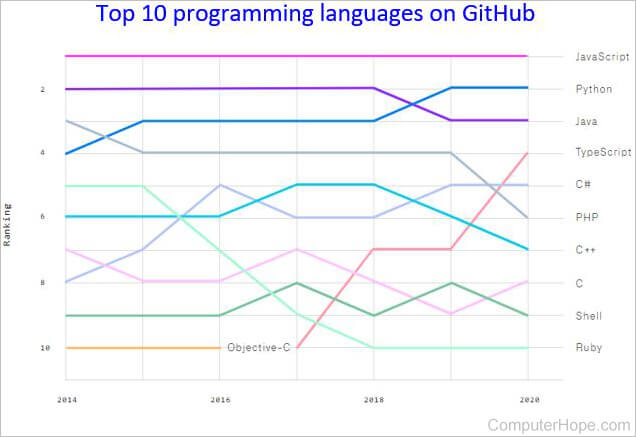
In the chart, you can see the top 10 languages are: JavaScript, Java, Python, PHP, C++, C#, TypeScript, Shell, C, and Ruby. The complete overview of growing languages list is on the GitHub Octoverse page.
If you’re learning to program, we recommend learning the language that will suit your needs or that others in your industry rather than the most popular language.
What is a Programming Language?
By  Priya Pedamkar
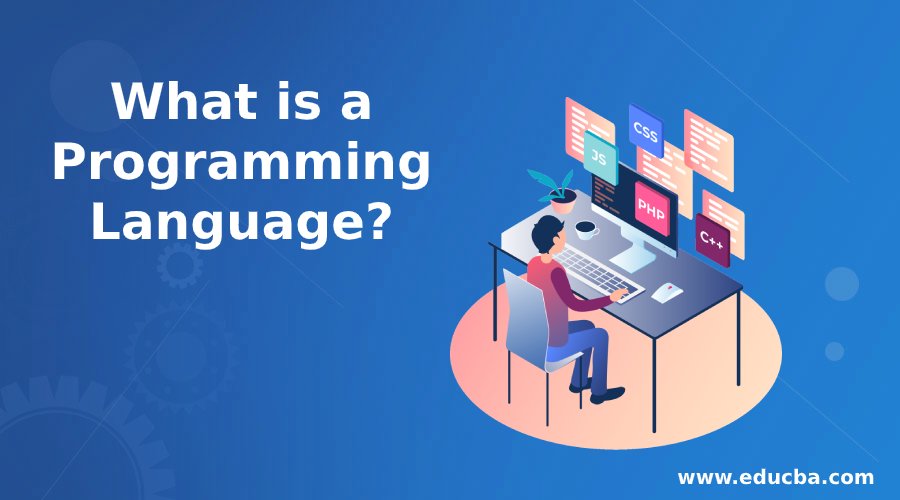
What is a Programming Language?
The following article provides an outline for What is a Programming Language? Humans have invented various languages to bridge the communication barrier. Languages are the way in which humans understand instructions. Computers are unable to understand the languages of humans. Binary is the only language that the computer understands. It enables humans to communicate with a computer in the language that the computer understands.
There is nothing but a set of instructions or written language that is given to the computer to perform certain tasks. These languages enable a computer to process a huge amount of data. High-level languages like Java, BASIC, C, C++, Pascal, Ada, COBOL, FORTRAN, etc., are generally considered programming languages. In short, it is a bridge that connects humans and computers.
Web development, programming languages, Software testing & others
Understanding
Everything from the Internet, Social Media platform to the operating system is developed from binary language. Computers are made up of/collection of enormous switches and understand only on and off a type of data. Computer work on the principle of a unique combination of switches that are either turned on or off. These switches are represented in the form of Binary code as 0 and 1. As there are billions of switches in the computers, it is impossible to give instruction to a computer by using a combination of 1 and 0. This is where the programming language plays an important role. Programming translates machine language into Human Language.
Each translates binary code and helps us to develop different web-based applications. Programming made it easy to connect humans with computers. Programming is easy to understand, write, and read compared to binary code, i.e. 1 and 0, as said earlier. With the help of programming languages, one can create numerous types of websites, applications, and software.
How it makes Working so Easy?
First, the computer program is written in a specific programming language like C, C++. After that computer compiler creates machine code from human-readable source code. The computer directly executes this machine code to perform certain tasks.
Previously, programmers used to write explicit instructions that manipulate the computer hardware. This machine language was extremely difficult to write. 10 to 20 machine language commands are required to perform a simple task. As code manipulates the computer hardware, machine languages are considered as ‘Low-Level Language.’

On the other hand, programming languages like Java, BASIC, C, C++, Pascal, Ada, COBOL, and FORTRAN, etc., are considered as ‘High-Level language’ or ‘compiled language’. In this programming, languages programmer write programs. With the help of a compiler, the programs are translated into machine language. Then the computer executes this machine language. Nowadays, most of the software is programmed in this way.
Uses of Programming Language
Advantages
Every programming language has its set of own advantages:
Required Skills
Below are some of the required skills to be an excellent programmer:
How Programming Language can help you in your Carrier Growth?
In today’s dynamic world, where everything changes at the speed of light, it plays an important role in the business world. Everything we see in the digital world developed with the help of programming languages. Professionals with programming skills have a lot of opportunities in this sector.
Computer programmers can make their flourishing careers in numerous fields as web developers, software developers, network and system administrators, Information security analysts, database administrators, computer system analysts, information research scientists, and many more. Everyone has different reasons for picking up different technologies, but learning programming languages surely benefit your skill set and offer a lot of growth opportunities and revenue.
Conclusion
Recommended Articles
This has been a guide to What is a Programming Language? Here we discussed the concepts, working, and advantages of programming language respectively. You can also go through our other suggested articles to learn more –
Programming Languages Training (41 Courses, 13+ Projects)
What is a Programming Language and Different Types
January 5, 2021 By admin
Different Programming Languages
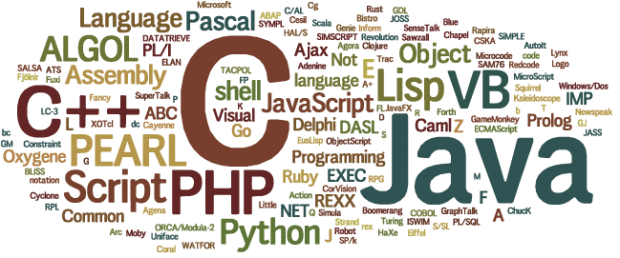
Nowadays, there are numerous programming languages are becoming more general and all-purpose, but these languages have their specialties, and each language has its own advantages and disadvantages. Usually, programming languages can be classified into a few types, however, these languages support multiple programming style. Every year there are a number of programming languages are implemented, but few languages are becoming very popular which may used by a professional programmer in their career.
Programming languages are used to control the performance of the computer or machine. At present, computer programmer has many choices to choose the language, but there are many differences between programming languages. So, this article gives a brief information regarding what are the different types of programming languages, differences between programming languages and types of programming languages in useful ways.
What is Programming Language?
A programming language is a notation designed to connect instructions to a machine or a computer. Programming languages are mainly used to control the performance of a machine or to express algorithms. At present, thousand programming languages have been implemented. In the computer field, many languages need to be stated in an imperative form, while other programming languages utilize declarative form. The program can be divided into two forms such as syntax and semantics. Some languages are defined by an SO standard like C language.
Types of Programming Languages
The different types of programming languages are discussed below.
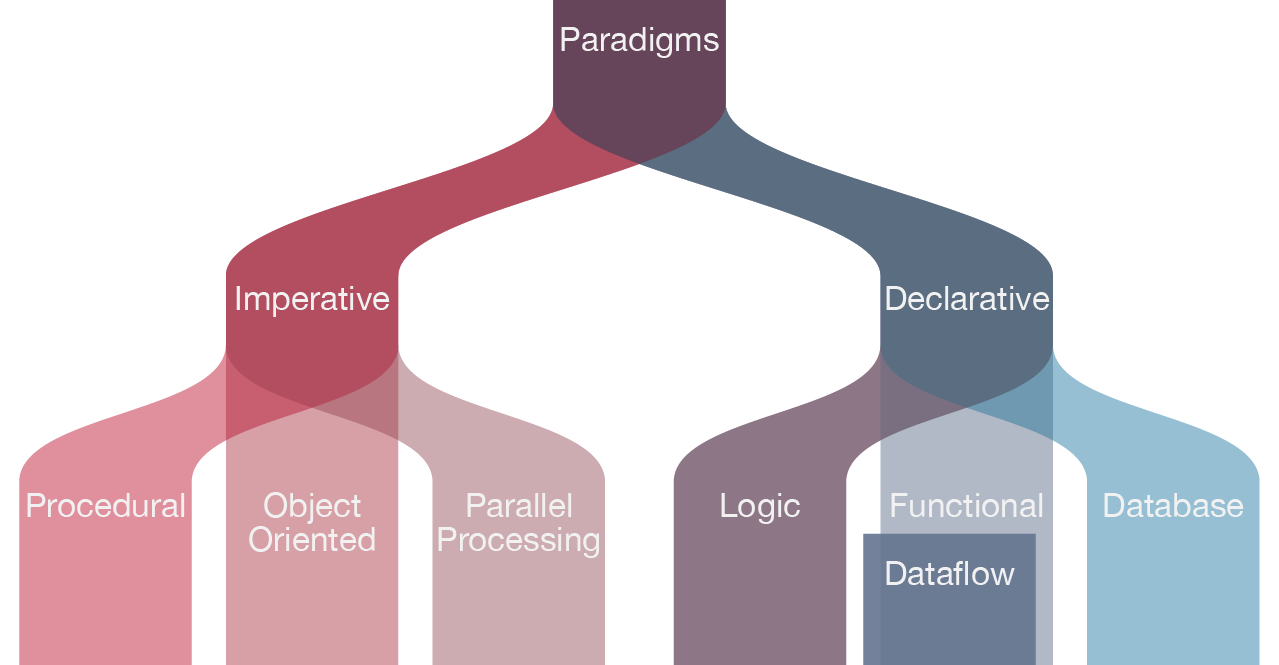
Procedural Programming Language
The procedural programming language is used to execute a sequence of statements which lead to a result. Typically, this type of programming language uses multiple variables, heavy loops and other elements, which separates them from functional programming languages. Functions of procedural language may control variables, other than function’s value returns. For example, printing out information.
Functional Programming Language
Functional programming language typically uses stored data, frequently avoiding loops in favor of recursive functions.The functional programing’s primary focus is on the return values of functions, and side effects and different suggests that storing state are powerfully discouraged. For example, in an exceedingly pure useful language, if a function is termed, it’s expected that the function not modify or perform any o/p. It may, however, build algorithmic calls and alter the parameters of these calls. Functional languages are usually easier and build it easier to figure on abstract issues, however, they’ll even be “further from the machine” therein their programming model makes it difficult to know precisely, but the code is decoded into machine language (which are often problematic for system programming).
Object-oriented Programming Language
This programming language views the world as a group of objects that have internal data and external accessing parts of that data. The aim this programming language is to think about the fault by separating it into a collection of objects that offer services which can be used to solve a specific problem. One of the main principle of object oriented programming language is encapsulation that everything an object will need must be inside of the object. This language also emphasizes reusability through inheritance and the capacity to spread current implementations without having to change a great deal of code by using polymorphism.
Scripting Programming Language
These programming languages are often procedural and may comprise object-oriented language elements, but they fall into their own category as they are normally not full-fledged programming languages with support for development of large systems. For example, they may not have compile-time type checking. Usually, these languages require tiny syntax to get started.
Logic Programming Language
These types of languages let programmers make declarative statements and then allow the machine to reason about the consequences of those statements. In a sense, this language doesn’t tell the computer how to do something, but employing restrictions on what it must consider doing.
To call these groups ” types of language ” is really a bit confusing. It’s easy to program in an object-oriented style in C language. In truth, most of the languages include ideas and features from various domains, which only helps to increase the usefulness of these types of languages. Nevertheless, most of the programming languages do not best in all styles of programming.
The Difference Between Different Programming Languages
C++ Language
The C++ language has an object oriented structure which is used in large projects. Programmers can collaborate one program into different parts or even one individual work on each part of the program. The structure of object oriented also permit code to be reused many times.This language is an efficient language. But, many programmers will disagree
C Language
Pascal Language
Pascal language is mostly a teaching language and few industries uses this language to write the programs. This language tends to use keywords instead of symbols and braces in C language. So this language is very easy for beginners to understand than a programming language like C, C++. Borland is a compiler software company, which is using Delphi programming language for industrial strength. Delphi is an object oriented language of Pascal, and presently Borland compilers only use it.
Fortran Language
Fortran language is a number crunching language and still it is used by scientists. This language allows different sizes of variables up to the memory limit in the machine. This language is suitable for engineers, who have to calculate values with high precision. Program in Fortran is inflexible and sometimes it makes difficult to read.

Java Language
The Java language is a multi platform language that’s particularly helpful in networking. Of course, mostly this language is used on the web with Java applets. However, this language is used to design cross platform programs, Since it similar to C++ in structure and syntax. For C++ programmers, Java language is very easy to learn and it offers some advantages provided by object oriented programming. Like reusability and it can be difficult to write efficient code in Java. But, nowadays the speed of the Java language has increased and 1.5 version offers some good features for easy program making.
Perl Language
Perl language is a file management language for UNIX. But it is more popular for its common gateway interface programming (CGI). It is a term for programs that web servers can perform to allow additional capabilities of web pages. Pearl language is a method for searching text and it is used for useful server functions and other databases, and it is very easy to pick up the fundamentals if you have any experience in any language. As a CGi language, web hosting services select Perl language over C++ language. Because, the web hosts can review Perl script files. Since they are text files, when C++ is compiled.
PHP Language
The PHP language is used to design web pages and sometimes it is also used as scripting language. This language is designed to develop a rapid website, and as a result comprises features which make it easy generate HTTP headers and link to databases. As a scripting language, it includes a set of components permit the programmer to easily get up to speed. However, it has more sophisticated object oriented features.
LISP Language
LISP language is mostly used in computer science research and it stores all data in lists such as arrays. The syntax of list is very simple and easy to make for developers to implement structures.
Scheme Language
The scheme language is an alternate of LISP language, and it has a simpler syntax and features. Any project under the scheme language will result in the re implementation of most of the LISP language. But, this is very popular introductory language in the computer science department of MIT’s. This language easily solves the problems instead of worrying about syntaxes of programming language.
This is all about the differences between programming languages and few major programming languages are discussed. And, the remaining languages like Tcl, Python, Smalltalk, COBOL, C# and Prolog are similar to the above languages which are discussed. But selecting the suitable language for developing a program or application is very important
Photo Credits:
Filed Under: Basics Tagged With: Programming
What is Programming Language? Definition & Types

Vinay Khatri
Last updated on August 2, 2022
Table of Content
We, humans, communicate with each other through various languages, such as English, French, Spanish, and many others. However, it is important that you use the language the other person understands in order to communicate.
When it comes to computer systems, they do not understand human languages, like English, French, Chinese, or any other; this is where programming languages come into play.
Let us divide ‘programming language’ into two terms: programming and language, to have a better understanding.
The term programming refers to the process of providing a set of instructions to a computer system to perform a certain task, while language is the primary means of communication. So, we can say that programming language is a type of language used to communicate with computer systems.
If you want to example more about a programming language, this article is for you. In this article, we shall make you familiar with what a programming language is and its various aspects.
Let’s get started!
What is Programming Language?
It is a method or a way of communication with computer systems so that a human can give instructions to the computer, and the computer can interpret those instructions and perform the task.
In technical terms, a programming language is a set of rules and keywords for writing a computer program (a series of instructions) that instructs the computer system to perform a specific task.
However, computer systems only understand the binary language, i.e., the language of 0s and 1s. In the early stages of computers, everything was programmed using the combination of 0s and 1s. Writing a program in the combination of 0s and 1s is not very easy as it becomes very large in size, complex, and time-consuming. Also, modern-day applications are very versatile, and programming them in the binary system is nearly impossible because they require millions and billions of 0s and 1s in combination.
So, today’s applications and programs are developed using programming languages. More interestingly, many software programs are available that convert the program you write in a programming language into a machine or binary language so that computers can understand what you want them to do.
How Does a Programming Language Work?
Now that you know what a programming language is. Let us now understand how it works.
Every programming language has its own syntax. Syntax refers to a set of rules that describes the structure of a language, i.e., combining the symbols correctly that a computer system can understand. Using the syntax of a programming language, it is possible to organize the set of instructions, which forms a computer program.
After writing a computer program, you need to compile it, where the instructions written in programming languages get converted into executable or machine code (0s and 1s). Now, the computer system interprets the machine code and performs the required actions. If any information is produced by executing those instructions, the computer system converts it into a form humans understand.
The Anatomy of a Programming Language
Any programming language has 5 core components. These are:
The syntax of a programming language defines the meaning of the various symbols pertaining to it. It is the set of rules that govern the what and how of any programming language. The syntax determines the way in which a programming language makes sense out of some code.
Learning the syntax of a programming language is far easier as compared to understanding the internal working of the same. Wrapping one’s head around a programming language’s syntax might take only a few days, while learning how the language works take much more time.
Programming languages store values at specific memory locations. The medium that fills the gap between the values to be stored and the actual memory locations is variables. A variable is a data item that is used in almost all computer programs. The value of variables is subjected to change multiple times during the execution of a computer program. Variables are of several types, known as data types, such as character, integer, and boolean.
Data structures determine the particular manner in which data is stored and organized efficiently in a programming language. Arrays, graphs, linked lists, and trees are instances of data structures.
A computer program is a set of instructions. To control the flow of a computer program i.e. in what sequence do the instructions carry out, is determined by using looping and control structures. A control or loop structure starts its operation by analyzing the variables that are fed to it. The course of action is determined by the nature and/or value of the variables.
Although not an inherent part of programming languages, tools are essential for productively using programming languages in modern times. A programming tool can be anything that improves, appends, quickens, or anything else to improve the computer program or its development.
Any programming language has a wide range of tool base that is only meant to grow, provided the programming language stays relevant. To understand these tools better, we can categorize them into several types. Notable types of programming tools are:
Types of Programming Languages
There are three types of programming languages.
1. Low-Level Programming language
A low-level programming language directly deals with the computer hardware and is present in the form of a Machine or binary language. We can say a low-level programming language is a native language for machines and computers. This type of language does not require a compiler or interpreter. So, programs written in low-level programming languages execute fast.
There are two types of low-level programming languages, as follows:
Machine language is in the form of 0s and 1s or in hexadecimal form (base 16). The programs you write in machine language do not require any converter because they are already in the form that the computer understands. Hence, they run fast than programs written in any other type of programming language.
Assembly language (ASM) is a programming language specially designed to communicate with the computer’s hardware. Programs written in an assembly language leverage an assembler to convert instructions into machine code. They consume less space and execute faster.
2. High-Level Programming Language
High-Level languages are the most legible programming language, and mostly, all high-level programming languages come with English syntax, making it easy for a developer or programmer to code. Such languages require a compiler or interpreter to convert a program into a machine or executable code.
Some popular high-level programming languages are Python, Java, PHP, JavaScript, Perl, Ruby, Objective-C, Swift, Pascal, and LISP. The primary advantage of high-level programming languages is they are easy to understand, code, and maintain.
High-level languages are of three types, as follows:
Procedural-oriented programming (POP) languages are based on the concept of a procedure call. Each procedure consists of a series of computational tasks that has to be performed. When you create a program in procedural-oriented language, you divide it into small routines or functions, where each function performs a specific task.
C, PASCAL, Basic, and Fortran are popular POP languages.
Object-oriented programming (OOPs) languages work on the concepts of objects, which are the combination of data and functions working on that data. Everything in OOPs is represented as an object. Its primary purpose is to combine data and functions together so that no other part of a program can access that data.
C++, Python, Java, and C# are popular OOPs languages.
Natural languages are human languages, such as English, Russian, French, German, etc. Developers primarily use these languages to carry out various tasks, like translation, topic segmentation, automatic summarization, and relationship extraction.
3. Mid-Level Programming Language
This type of language lies between low-level and high-level programming languages. We also refer to mid-level language and pseudo-language or intermediate language. It is close to the machine as well as easily understandable by humans. C and C++ are popular examples of mid-level languages.
Programming Languages
The following highlights some of the popular programming languages available today:
| C | Python | C++ |
| C# | R | Ruby |
| COBOL | ADA | Java |
| Fortran | BASIC | Altair BASIC |
| True BASIC | Visual BASIC | GW BASIC |
| QBASIC | PureBASIC | PASCAL |
| Turbo Pascal | GO | ALGOL |
| LISP | SCALA | Swift |
| Rust | Prolog | Reia |
| Racket | Scheme | Shimula |
| Perl | PHP | Java Script |
| CoffeeScript | VisualFoxPro | Babel |
| Logo | Lua | Smalltalk |
| Matlab | F | F# |
| Dart | Datalog | dbase |
| Haskell | dylan | Julia |
| ksh | metro | Mumps |
| Nim | OCaml | pick |
| TCL | D | CPL |
| Curry | ActionScript | Erlang |
| Clojure | DarkBASCIC | Assembly |
Popular Programming Languages
Currently, we have a plethora of programming languages, where some languages are general-purpose, and some are specialized. New programming languages pop up every now and then. While some succeed in attracting attention, others fall into oblivion. In no way the following list is a complete list of all the popular programming languages, but it will give you some good ideas:
Uses of Programming Languages
The most basic use of programming language is to communicate with a computer and instruct them to carry out a specific job. It is used to create every software program, website, game, and all other digital content and electronic devices. Also, a programming language plays a crucial role in various domains, including cloud computing, the Internet of Things (IoT), artificial intelligence and machine learning, and aerospace.
Each programming language has its own applications or uses. The following are some popular programming languages and their uses:
Conclusion
That’s all about a programming language. It is the backbone of this digital world. Everything we see in this digital world, from every electronic device, whether it is a refrigerator or air conditioner, to software programs and websites, is operable because of programming languages.
So, if you learn and master programming languages, you will find a galore of career opportunities. However, learning and mastering programming languages requires strong determination and a lot of dedication and practice.
Choose the appropriate programming language and get started with it.
People are also reading:
14 DIFFERENT PROGRAMMING LANGUAGES AND THEIR USES EXPLAINED.
Computer programming languages allow us to give instructions to a computer in a language the computer understands. Just as many human-based languages exist, there are an array of computer programming languages that programmers can use to communicate with a computer. The portion of the language that a computer can understand is called a “binary.” Translating programming language into binary is known as “compiling.” Each language, from C Language to Python, has its own distinct features, though many times there are commonalities between programming languages.
These languages allow computers to quickly and efficiently process large and complex swaths of information. For example, if a person is given a list of randomized numbers ranging from one to ten thousand and is asked to place them in ascending order, chances are that it will take a sizable amount of time and include some errors.
There are dozens of programming languages used in the industry today. We’ve compiled overviews of the 14 most important, relevant and in-demand of these languages below.
The great-grandmother and lingua franca of all programming languages, C was first released in 1972 — that’s a whopping 45 years ago!
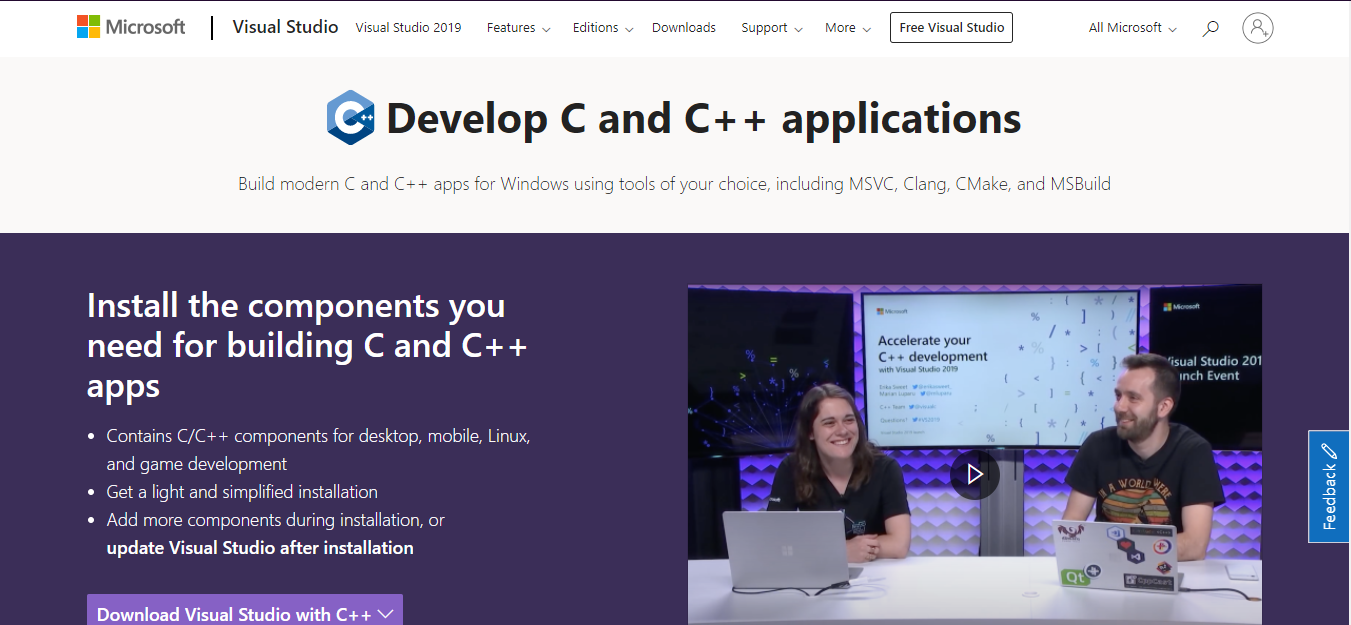
During the past decades, it has become one of the most widely used programming languages ever to exist. It’s used for creating a variety of programs for computers, such as operating systems, for instance.
If you’re interested in learning C, let me tell you this: it’s not going to be a walk in the park.
C has a slightly cryptic syntax, so it takes some time to get familiar with. But once you get past that, learning the language is considered rather straightforward.
Also, what’s great about learning C is that when you master it, it’s so much easier to start learning another language.
Because C has been around forever, it’s had a strong influence on some other programming languages, too. You’ll be able to find familiar bits and pieces in C# and C++, Java, JavaScript, PHP, and Python, for instance.
SHOULD I LEARN C?
C isn’t the most popular or trendy programming language out there. But it’s a solid player in the field with a longer history than most programming languages that are still in use.
Learning C will give you a good overview of the evolution of programming during the past 40+ years. You’ll find plenty of developers who used C even before the Internet came to exist.
One major downside of C is that it’s somewhat difficult to learn for beginners.
Thus, if you’re looking for the best first programming language to learn, I’d suggest going with a more high-level language like Python. High-level programming languages are easier to “read”. That means you can focus on learning the fundamentals of programming instead of spending too much time understanding how a single programming language works.
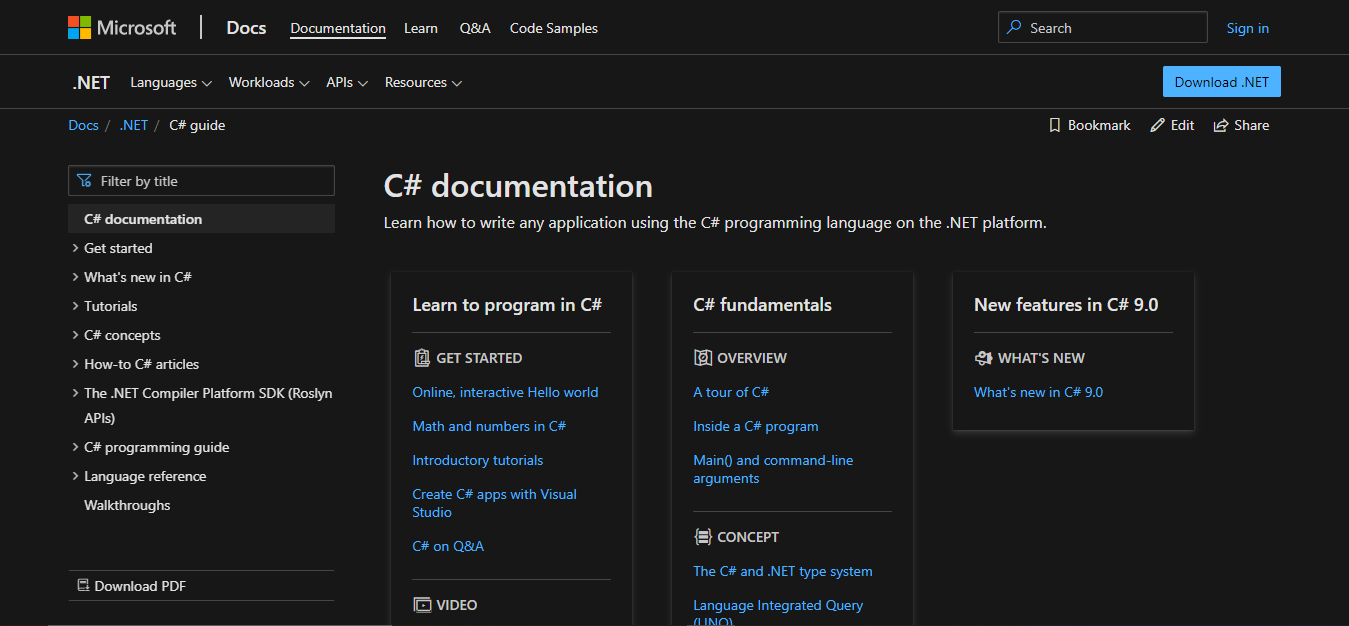
C# was originally designed to be easy to learn and use. Obviously that makes it a simple language to start with.
C# a high-level language, meaning that it reads a bit like English. On top of that, it abstracts away a lot of those complex tasks needed to make sure the computer is able to deal with your code — contrary to C++, for instance.
However, it’s still not as high-level as Python, for example — and therefore not quite as easy for a beginner to learn.
SHOULD I LEARN C#?
C# is the main programming language for developing software and programs for Microsoft. That said, if you’re interested in building applications for the Microsoft platform, C# is the perfect choice for you.
Another popular application for C# is game development. If you want to work in the gaming industry, C# is an excellent choice. It’s the recommended language for building games on the Unity game engine, for example.
C++ is based on C, the indisputable dinosaur of programming languages still in use.
C++ a powerful, high-performance language, but it’s rather lower-level. Low-level programming languages use a lower degree of abstraction, meaning that the code is more difficult to “read”.
Learning a low-level language requires more time spent on understanding how the language itself works. That means you will have less time to dedicate to learning the basics of how computer programming works in general.
Also, if you’re coding an app from scratch with C++, you will need to write a lot of code. That said, projects written in C++ are often more difficult to maintain and manage. If you work with an entire team of developers, things will of course be easier.
On the other hand, C++ is very scalable and efficient. Heaps of resource-intensive programs often use C++, like some of the most beautiful 3D games you’ve seen.
Once you get more confident with C++, you can use it for lots of different projects. C++ is great for coding computer software, mobile apps, game engines and games, or web applications.
SHOULD I LEARN C++?
If you’re interested in learning C++, remember that it’s a very complex language to learn. Therefore, make sure you have a well-rounded mentor to support you along the way.
If you’re aiming at taking on big projects where you wish to have a lot of control of how the programs execute, C++ is most likely a good choice. Even more so if you already know C — that’ll be somewhat of a prerequisite for learning C++ anyways.
Once you master C++, learning other programming languages will be much easier.
4. HTML
HyperText Markup Language or HTML is used to creating structured content for all websites out there.
Rather a markup language than a programming language, HTML creates the structure and content of a web page. You use HTML to insert text, images, or other media into a web page.
Everything you see on a website gets its fundamental characteristics from the HTML code written by a web developer.
For a kick-start into learning HTML, make sure to grab your FREE HTML cheat sheet below:
For even more great learning resources, here are the best online courses for learning HTML for beginners. Hand-picked, tested, recommended!
SHOULD I LEARN HTML?
YES! HTML is super easy to learn, and it’s the foundation of every website and web app you’ve ever used.
You can learn the basics of HTML over the weekend and start building your web development skills step-by-step.
For the best resources for learning HTML, head over to my recommended online courses for learning HTML for beginners.
If you’re like me and you prefer learning from a book, check out my book review on HTML and CSS: Design and Build Websites by Jon Duckett.
Also, when you start learning HTML, be prepared to learn CSS and JavaScript, too. These three languages form the basic building blocks of the Web.
5. CSS
CSS or Cascading Style Sheets is the language web designers and web developers use to create the look and design of a website.
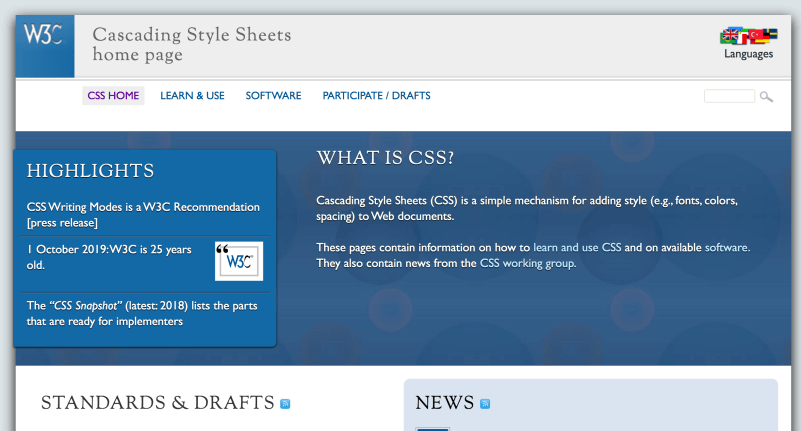
Whereas HTML creates the structure and contents for a website, like paragraphs, headings, and images, CSS takes those elements and makes them look pretty.
If you’re interested in building websites, you must learn CSS at some point. Luckily, CSS is easy and quick to learn. It’s also one of the most motivational languages for beginners, because you see the output from your code instantly.
However, even though you can learn the basics of CSS in just a few days, it can take years to master the more advanced tricks with confidence.
Now, one could point out that CSS is just a style sheet language and not a “proper” programming language. But since CSS is one of the cornerstones of web development, it’s got a spot on this list.
Here are a couple of helpful articles you may want to read, too:
SHOULD I LEARN CSS?
If you want to build websites in the future, you MUST learn CSS. Together with HTML and JavaScript, CSS forms the third fundamental pillar of front-end skills you must master as a web developer or web designer.
Also, if you want to make money already while you learn coding, the fastest and easiest way to get your first mini jobs is to learn HTML, CSS, and JavaScript.
You can start earning money in a matter of weeks with small gigs on freelancing websites like UpWork. At the same time, you can gradually build yourself a nice web developer portfolio to get bigger jobs step-by-step. Once you feel confident enough, you can start applying for your first entry-level front-end developer jobs.
6. JAVA
Java is one of the most popular and widely-used programming languages in the world.
You can use Java for a variety of different projects, from Android smartphone apps to complete desktop applications.
At the time of updating this article, Java is in fact holding the 3rd place in the TIOBE Index that ranks programming languages based on how often people search for them on the most common search engines.
The fundamentals of Java actually stem from C++, but Java is a bit easier to learn and use, especially for beginners.
For instance, one of the fundamental ideas the developers of Java had was to create a programming language that would allow their code to run on two devices that were nothing alike. That’s where the slogan of Java comes from: “ write once, run anywhere “.
That said, Java is popular across all platforms, operating systems, and devices. This versatility and flexibility also make Java one of the most in-demand and highest paying programming languages you can learn.
SHOULD I LEARN JAVA?
If you’re not quite sure yet what it is that you want to accomplish with coding, Java could be a good option thanks to its versatility.
All in all, Java is a great asset to have when you start applying for your first developer jobs.
However, you can also find other programming languages that are more beginner-friendly and require less code to create an entire app from scratch. You could try Python or Ruby, for example.
Java is also the most useful programming language for Android mobile development. If you wish to become a full-time Android developer, check out these top mobile development courses for Android on Udemy.
7. JAVASCRIPT
Not to be confused with Java, JavaScript is the programming language of the Web. It breathes life into websites, making them more interactive, interesting to use, and user-friendly.
These days almost every web page you use daily uses JavaScript. Needless to say, it’s one of the most popular web development languages and among the most powerful programming languages out there — therefore being an excellent skill to possess in the job market.
Different frameworks and libraries — such as AngularJS and jQuery or React — make using JavaScript for front-end development even more efficient and interesting.
JavaScript is a client-side language itself, meaning that the code is executed on the user’s browser.
However, with new technologies such as Node.js, it can also be used as a server-side language. This makes JavaScript even more powerful through the additional versatility, ultimately making it a full-stack language.
SHOULD I LEARN JAVASCRIPT?
If you want to become a front-end web developer, you have to learn JavaScript at some point. You simply can’t build a full-scale website without it.
Pair JavaScript with HTML and CSS and you’ve got a complete portfolio of skills to get your first front-end developer job!
Also, JavaScript is one of the “hottest” and best programming languages for web development at the moment.
Hence, you won’t have any trouble finding a job once you master JavaScript. Its popularity just seems to be increasing with new front-end frameworks appearing out of thin air on a regular basis.
8. OBJECTIVE-C
Objecive-C is the primary language by Apple for developing programs for Mac OS X and iOS.
First developed in the ’80s, Objective-C has since gained momentum along with the growing popularity of iOS.
Objective-C is a powerful and flexible programming language based on the C language. However, it’s not the easiest programming language to learn for beginners.
Even though Objective-C is the most useful programming language for Apple devices, the general trend in app development for Apple’s devices is going in the direction of Swift.
We’ll see what happens with Objective-C in the future, but for now its still a valuable and necessary programming language to learn for iOS development.
SHOULD I LEARN OBJECTIVE-C?
If you want to create apps for the App Store, Objective-C is a necessary skill you need to learn.
When you start learning Objective-C, be prepared to learn Swift, too. The combination of these two programming languages will give you solid skill set for iOS development for a looooong time!
9. PERL
Perl is a high-level scripting language that first appeared in 1987 and has since developed into a small family of two separate languages, Perl 5 and Perl 6.
What Perl was originally meant for was text processing and manipulation, but it has since found further applications ranging from web development to system administration.
Perl evolved throughout the years into a powerful tool that can be used on pretty much any operating system on the planet. Therefore, it’s sometimes referred to as the “Swiss army knife” of computer languages, too.
Perl takes its best features from other programming languages such as C, for instance. It’s comparable to PHP or Python to a certain extent, too.
However, in contrast to Python, Perl usually offers multiple solutions to a single problem. In this way it’s similar to Ruby, where there’s no one single best way to solve a specific problem.
If you’re a beginner programmer, keep in mind that Perl comes with a few somewhat daunting features like any other programming language.
For example, it’s famous for the overflowing use of confusing symbols in its syntax. So, the code might look a bit overwhelming for a beginner at first glance.
SHOULD I LEARN PERL?
Perl is a powerful and versatile programming language. Once you get the hang of it, it’s not that difficult to learn.
However, if you want to get a developer job in the future, make sure your potential employers actually use Perl.
Since it’s not the most popular programming language out there, you could run into problems trying to find a company you’d like to work for as a Perl developer.
10. PHP
PHP is a scripting language running on the server side to create web pages written in HTML.
It’s a relatively easy language to use for new developers, making it one of the most popular programming languages out there. In fact, 80% of the top 10 million websites currently use PHP.
Interestingly enough, PHP was never really intended to become a programming language. It was originally created to be a toolset to help its creator, Rasmus Lerdorf, maintain his Personal Home Page (PHP).
That aside, PHP has since become one of the most popular scripting languages on the Web.
Being a server-side language just like Python or Perl are, PHP can do things such as creating login pages, photo galleries, discussion forums, and much more.
Websites employing PHP include some lovely treats we all are familiar with, like WordPress, Facebook, and Tumblr.
SHOULD I LEARN PHP?
Since PHP is easy to get started with, it’s a great choice for a beginner programmer.
Additionally, PHP is the most useful programming language for WordPress development.
If you’re planning to become a freelance web developer, PHP is a safe choice: WordPress and other content management systems often use PHP.
11. PYTHON
Python is one of the most beginner-friendly programming languages you will find. It’s perfect for learning the fundamentals of programming if you’re just starting out with coding.
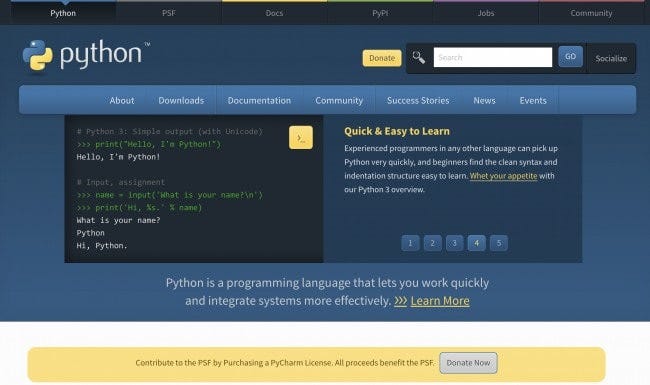
Python is easy to learn because it reads almost like English. So, you don’t have to spend that much time understanding how the language itself works, since it’s so intuitive and clean.
This means you can dedicate more time to learning what programming is all about and learn the basics of coding in general.
Moreover, Python is also a versatile programming language that you can use for a variety of different coding projects, like
· Data mining and visualization
· Game development etc.
SHOULD I LEARN PYTHON?
If you want to see results quickly and build meaningful projects from the beginning, Python is a great choice. You will have no problem finding helpful resources for learning Python online.
Also, you don’t have to worry about feeling left alone at any point. The strong and supportive community around Python will take care of their kin.
So whenever the road gets rocky, you can rely on receiving help from Q&A sites like StackOverFlow.
I know learning programming can feel a bit overwhelming and it’s difficult to know what you want to do in the future. Python lets you create so many different projects from data mining to game development that you can start learning it and see what you like the most as you progress.
For a kick-start into learning Python, have a look at my post about learning Python with Python Crash Course. It was my very first coding book ever and it taught me everything I needed to know to start pursuing web development as a full-time job.
12. RUBY
Ruby is a very high-level, multi-purpose programming language first released in 1995.
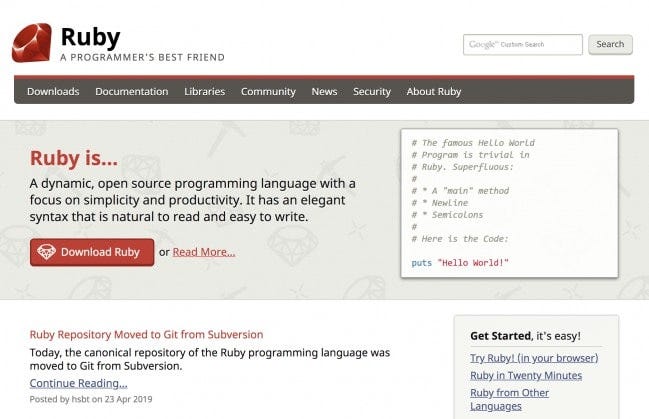
It’s one of the most fun and creative programming languages to work with, because you will most often find several ways to solve a specific problem.
Learning Ruby will definitely reward you with a steep learning curve and seeing results fairly quickly. For instance, you can build a web application from scratch surprisingly fast using the Ruby on Rails framework.
Therefore, Ruby is the most useful programming language for launching web apps as quickly as possible among startups and small businesses.
SHOULD I LEARN RUBY?
If you’re interested in quick progress and creating an entire application from scratch (even just by yourself), Ruby is the most useful programming language to see results quickly.
Pair it with the Rails framework and you can build a web app faster than you expected.
Above all, Ruby is popular among small tech companies. So, if that’s the segment you want to work in at some point, Ruby could be a safe choice as your first programming language.
To be sure about the demand in the job market, just do some research online and find out which programming languages your potential future employers use.
If you’re looking for a beginner-friendly course to learn Ruby and Rails, I’d recommend The Complete Ruby on Rails Developer Course on Udemy. It’s the first Ruby course I took and I loved it. Highly recommended — the over 50,000 students can’t be wrong!
13. SQL
SQL or Structured Query Language is the most common language used for managing data stored in relational database management systems (RDBMS).
You can’t imagine how much data companies store in their databases these days. Knowing how to use SQL to manage and analyze the massive amounts of data is a valuable skill in the job market.
Businesses need people who can sift through the databases and help them draw conclusions from them. For example, data analysts at Amazon create demand forecasts before Christmas to prepare and pre-pack millions of items for customers who are likely to order them before the holidays.
In a similar way, airlines sift through their past bookings for forecast demand for flights in the future. That’s how they know how many tickets they can sell at a higher price for each individual flight. Yep, that’s why you’re paying a fortune for flights during holidays.
That said, understanding how data can be used in a sensible way to gain insight into customer behaviour, for instance, is a skill in high demand in the job market these days! Even if you are not aiming at becoming a data analyst yourself, basic SQL skills will be an advantage in terms of being aware of the possibilities data mining offers.
SHOULD I LEARN SQL?
If you enjoy analyzing data and using it for drawing valuable conclusions from it, SQL is the most useful programming language to learn. For example, if you enjoy statistics and math in general, data analysis could be something you’ll do a great job at.
Once you master SQL and database management, you can work in pretty much any industry around the world. And more importantly, you will have no trouble finding a job anytime soon!
14. SWIFT
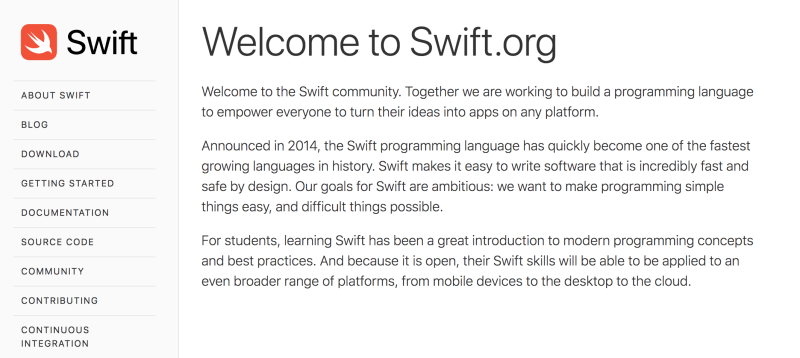
Hence, Swift is aimed at iOS and OS X developers, giving them the perfect tools for creating the next big thing on the app market.
Considering the huge demand in the mobile app market, it’s no surprise that Swift quickly became very popular. It scales nicely and it’s fast. Furthermore, Swift is heavily influenced by Ruby and Python, so it’s very beginner-friendly and easy to use.
However, since it’s somewhat of a freshman compared to other languages, the support community for Swift might be a bit smaller than for the more established languages in the bunch. But like with any other language, it’s just a matter of time.
SHOULD I LEARN SWIFT?
Swift is your weapon of choice if you’re looking to develop native apps for Mac OS or iOS. Since the future of Apple seems quite promising at the moment, Swift can be a good investment if your long-term goals relate to iOS development.
Pairing Swift with Objective-C is probably the best way to go in that case, since understanding Objective-C code will definitely be required from a serious iOS developer.
FINAL THOUGHTS: DIFFERENT PROGRAMMING LANGUAGES AND THEIR USES —
There ya go! these popular programming languages and their uses should help you choose one to start learning. I hope this post was helpful for learning more about what each programming language is good for.
Just keep in mind that what matters more is that you know why you want to learn programming in the first place.
When you know what you want to create with coding in the future, you will learn any programming language much quicker.
To help you get started, I’ve put together a helpful post with 6 easy steps to get started with coding. I’ll see you there!
The bottom line is that it doesn’t really matter which programming language you start with. Whether you’re interested in web development or data analysis, all that matters is that you just start, simple as that!
What do you think? Which ones are you interested in? Drop me a line in the comments below!