What is swot analysis
What is swot analysis
What Is SWOT Analysis? It’s Time to Get to Know Your Business
How well do you know your business’s strengths and weaknesses? What about your opportunities and threats? If you’re coming up short on answers, you need to conduct a SWOT analysis. So, what is SWOT analysis?
Whether you’re a newbie or veteran entrepreneur, creating a SWOT analysis can help you evaluate your business, implement changes, and improve operations. Read on to get started.
What is SWOT analysis?
A SWOT analysis is a business technique that identifies a business’s strengths, weaknesses, opportunities, and threats. The purpose of SWOT analysis is to look at internal and external factors that influence a business’s successes and shortcomings. Use this tool to establish goals, your competitive position, and a small business growth strategy.
Brad Touesnard, Founder & CEO of SpinupWP, provided insight into the importance of SWOT analysis, saying:
A SWOT analysis allows you to identify the areas you could be focusing on to grow your business. You can use this insight to inform your long-term strategic planning, which will help you to draw up budgetary plans and identify hiring needs.”
You should create a SWOT analysis small business when starting your business. And, you should update your SWOT annually. To conduct a SWOT analysis, you need to do research (e.g., market analysis) and dive into your business’s data (e.g., financial statements). After gathering information, arrange your results using a four-quadrant diagram.
Most of the time, you can use this technique to analyze your business’s overall operations. But, you can also create a focused SWOT that helps you analyze a particular project.
Ready to get into what exactly a SWOT tells you? Here’s a breakdown of SWOT analysis meaning:
Strengths
Your business’s strengths are the internal aspects of your company that put you ahead of your competition and give you the upper hand when attracting customers.
Strengths also include valuable employees who work for your business. A skillful, kind, and knowledgeable staff sets successful businesses apart from unsuccessful businesses.
Your business’s assets, or property, are also strengths. You have tangible assets, which are physical items, and intangible assets, or non-physical property.
Once you identify your business’s strengths, cater to them. See how you can highlight what your business does best when marketing, cross-selling or upselling, or developing new offerings.
Examples of business strengths:
Weaknesses
In the weakness section of your SWOT analysis, detail things within your business that prevent it from surpassing competitors. To get started, think about your operations. You can also consider what your competitors do better than your business.
So, what does your company lack? What types of limitations do you face when operating? Your business might be weak in some areas by having too broad a vision, mission, or brand. If your business is all over the place, you won’t resonate with your audience.
When you determine your business’s weaknesses, you and your employees should come up with methods to improve them.
Examples of business weaknesses:
Opportunities
Your SWOT analysis’s opportunities section looks at external aspects that could give your business a boost. Opportunities are industry- or market-related factors that give your company an advantage over your competition.
Talking about a SWOT analysis’ usefulness in competitive analyses, Malte Scholz, CEO and CPO of Airfocus, says:
SWOT analysis can help you analyze the competition and identify potential gaps in the market. This way, you will be able to position yourself much faster and answer the current needs of your target audience. In order for SWOT analysis to reveal valuable insights, however, it must be executed thoroughly, without rush.”
To determine your opportunities, look at what’s happening outside of your business. Some opportunities are temporary while others are permanent.
Opportunities might make it possible to increase sales or improve your chances of attracting new customers. Regularly determine opportunities and take advantage of them. If opportunities are only temporary, come up with ways to bounce back after the opportunity passes.
Examples of business opportunities:
Threats
Like opportunities, threats are external factors that can harm your business. Although these are often out of your control, identifying threats can help you prepare against them. Like opportunities, threats can be temporary or permanent.
Threats might come from new or improved competitors. Or, they can stem from weaknesses. For example, you might receive negative reviews as a result of a disengaged employee.
You may also see changes in the market that result in a lack of demand. A recession might lead to a lack of consumer spending. Threats might also be due to the environment, like droughts, hurricanes, or severe blizzards.
Although you can’t control threats, you can choose how you react to them. And, you might be able to find opportunities among threats (e.g., federal aid during declared disasters and emergencies). Brainstorm ways to adapt your business when facing threats.
Examples of business threats:

Sometimes, these threats can present opportunities. Download our FREE whitepaper, Business Guide to Navigating Through Disasters & Emergencies, for overviews and government links.
3 Tips for conducting a SWOT analysis for small business
Now that you know the importance of SWOT analysis, you might be wondering where to start. If you’re ready to create a SWOT analysis of a company, use the following tips:
1. Create a SWOT analysis template
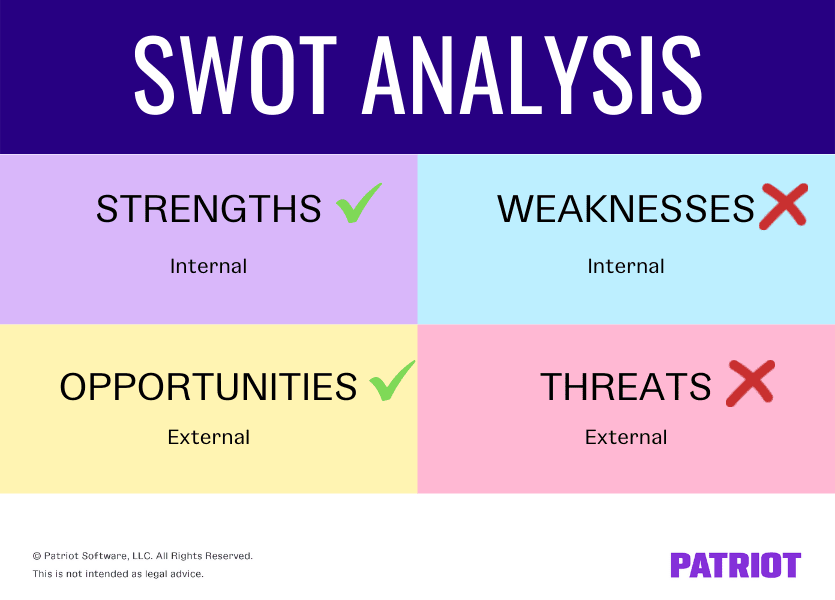
To prevent disorganized information, use a standard SWOT analysis template. Again, the template is a four-quadrant diagram.
You can create a SWOT analysis in a few simple steps:
Use a standard template to make it easier to compare current and past SWOT analyses. Take a look at an example template of a SWOT analysis of small business enterprise:
2. Involve your employees
You’re not the only person who knows your business inside and out. Your employees have the scoop on your company’s day-to-day triumphs and struggles. They can reveal strengths, weaknesses, opportunities, and threats you didn’t know or forgot existed.
Have regular SWOT planning meetings with some or all of your employees to get more perspectives and ideas. Or, you might have individual SWOT meetings with departments (e.g., marketing).
Involving employees also makes it easier to implement changes. When employees know what’s going on, they can take the appropriate actions. And, employees may be more willing to improve on something if they are part of the decision-making.
Keep the conversation going after meetings. Send out quick emails or host additional meetings for further strategizing.
3. Use the results of your analysis
Creating a SWOT analysis isn’t going to do much if you don’t do anything with the results. Use your SWOT analysis to set goals and objectives.
You can use your SWOT analysis to:
Pro tip: Your business’s strengths, weaknesses, opportunities, and threats are always changing. Regularly create a SWOT analysis (e.g., annually) to grow your business.
SWOT analysis example: Small business
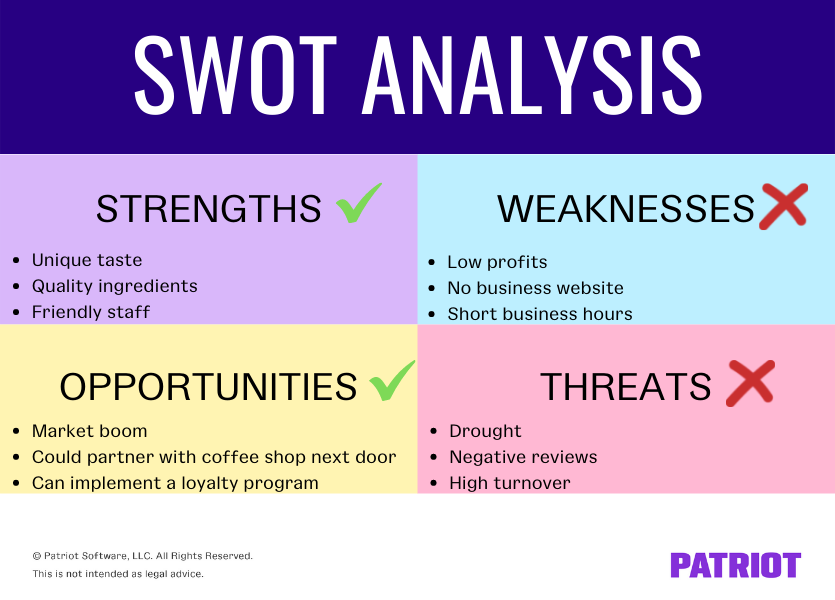
Let’s take a look at a SWOT analysis example for a small bakery. After doing some internal and external research, you categorize aspects of your business as follows:
This is not intended as legal advice; for more information, please click here.
Strength, Weakness, Opportunity, and Threat (SWOT) Analysis
:max_bytes(150000):strip_icc()/wk_headshot_aug_2018_02__william_kenton-5bfc261446e0fb005118afc9.jpg "What is swot analysis. Смотреть фото What is swot analysis. Смотреть картинку What is swot analysis. Картинка про What is swot analysis. Фото What is swot analysis")
:max_bytes(150000):strip_icc()/ScreenShot2021-11-19at10.19.47AM-f4c32b98185a44faa52a810e41088308.png "What is swot analysis. Смотреть фото What is swot analysis. Смотреть картинку What is swot analysis. Картинка про What is swot analysis. Фото What is swot analysis")
:max_bytes(150000):strip_icc()/ArielCourage-50e270c152b046738d83fb7355117d67.jpg "What is swot analysis. Смотреть фото What is swot analysis. Смотреть картинку What is swot analysis. Картинка про What is swot analysis. Фото What is swot analysis")
What Is SWOT Analysis?
SWOT (strengths, weaknesses, opportunities, and threats) analysis is a framework used to evaluate a company’s competitive position and to develop strategic planning. SWOT analysis assesses internal and external factors, as well as current and future potential.
A SWOT analysis is designed to facilitate a realistic, fact-based, data-driven look at the strengths and weaknesses of an organization, initiatives, or within its industry. The organization needs to keep the analysis accurate by avoiding pre-conceived beliefs or gray areas and instead focusing on real-life contexts. Companies should use it as a guide and not necessarily as a prescription.
Key Takeaways
SWOT Analysis
Understanding SWOT Analysis
SWOT analysis is a technique for assessing the performance, competition, risk, and potential of a business, as well as part of a business such as a product line or division, an industry, or other entity.
Using internal and external data, the technique can guide businesses toward strategies more likely to be successful, and away from those in which they have been, or are likely to be, less successful. Independent SWOT analysts, investors, or competitors can also guide them on whether a company, product line, or industry might be strong or weak and why.
SWOT analysis was first used to analyze businesses. Now, it’s often used by governments, nonprofits, and individuals, including investors and entrepreneurs. There is seemingly limitless applications to the SWOT analysis.
Components of SWOT Analysis
Every SWOT analysis will include the following four categories. Though the elements and discoveries within these categories will vary from company to company, a SWOT analysis is not complete without each of these elements:
Strengths
Strengths describe what an organization excels at and what separates it from the competition: a strong brand, loyal customer base, a strong balance sheet, unique technology, and so on. For example, a hedge fund may have developed a proprietary trading strategy that returns market-beating results. It must then decide how to use those results to attract new investors.
Weaknesses
Weaknesses stop an organization from performing at its optimum level. They are areas where the business needs to improve to remain competitive: a weak brand, higher-than-average turnover, high levels of debt, an inadequate supply chain, or lack of capital.
Opportunities
Opportunities refer to favorable external factors that could give an organization a competitive advantage. For example, if a country cuts tariffs, a car manufacturer can export its cars into a new market, increasing sales and market share.
Threats
Threats refer to factors that have the potential to harm an organization. For example, a drought is a threat to a wheat-producing company, as it may destroy or reduce the crop yield. Other common threats include things like rising costs for materials, increasing competition, tight labor supply. and so on.
SWOT Table
Analysts present a SWOT analysis as a square segmented into four quadrants, each dedicated to an element of SWOT. This visual arrangement provides a quick overview of the company’s position. Although all the points under a particular heading may not be of equal importance, they all should represent key insights into the balance of opportunities and threats, advantages and disadvantages, and so forth.
The SWOT table is often laid out with the internal factors on the top row and the external factors on the bottom row. In addition, the items on the left side of the table are more positive/favorable aspects, while the items on the right are more concerning/negative elements.
:max_bytes(150000):strip_icc()/swot3-a5efa84709d24647ac8a88b556899f9c.png "What is swot analysis. Смотреть фото What is swot analysis. Смотреть картинку What is swot analysis. Картинка про What is swot analysis. Фото What is swot analysis")
How to Do a SWOT Analysis
A SWOT analysis can be broken into several steps with actionable items before and after analyzing the four components. In general, a SWOT analysis will involve the following steps.
Step 1: Determine Your Objective.
A SWOT analysis can be broad, though more value will likely be generated if the analysis is pointed directly at an objective. For example, the objective of a SWOT analysis may focused only on whether or not to perform a new product rollout. With an objective in mind, a company will have guidance on what they hope to achieve at the end of the process. In this example, the SWOT analysis should help determine whether or not the product should be introduced.
Step 2: Gather Resources.
Every SWOT analysis will vary, and a company may need different data sets to support pulling together different SWOT analysis tables. A company should begin by understanding what information it has access to, what data limitations it faces, and how reliable its external data sources are.
In addition to data, a company should understand the right combination of personnel to have involved in the analysis. Some staff may be more connected with external forces, while various staff within the manufacturing or sales departments may have a better grasp of what is going on internally. Having a broad set of perspectives is also more likely to yield diverse, value-adding contributions.
Step 3: Compile Ideas.
For each of the four components of the SWOT analysis, the group of people assigned to performing the analysis should begin listing ideas within each category. Examples of questions to ask or consider for each group are in the table below.
Internal Factors
What occurs within the company serves as a great source of information for the strengths and weaknesses categories of the SWOT analysis. Examples of internal factors include financial and human resources, tangible and intangible (brand name) assets, and operational efficiencies.
Potential questions to list internal factors are:
External Factors
What happens outside of the company is equally as important to the success of a company as internal factors. External influences, such as monetary policies, market changes, and access to suppliers, are categories to pull from to create a list of opportunities and weaknesses.
Potential questions to list external factors are:
| Strengths 1. What is our competitive advantage? 2. What resources do we have? 3. What products are performing well? | Weaknesses 1. Where can we improve? 2. What products are underperforming? 3. Where are we lacking resources? |
| Opportunities 1. What new technology can we use? 2. Can we expand our operations? 3. What new segments can we test? | Threats 1. What regulations are changing? 2. What are competitors doing? 3. How are consumer trends changing? |
Companies may consider performing this step as a «white-boarding» or «sticky note» session. The idea is there is no right or wrong answer; all participants should be encouraged to share whatever thoughts they have. These ideas can later be discarded; in the meantime, the goal should be to come up with as many items as possible to invoke creativity and inspiration in others.
Step 4: Refine Findings.
With the list of ideas within each category, it is now time to clean-up the ideas. By refining the thoughts that everyone had, a company can focus on only the best ideas or largest risks to the company. This stage may require substantial debate among analysis participants, including bringing in upper management to help rank priorities.
Step 5: Develop the Strategy.
Armed with the ranked list of strengths, weaknesses, opportunities, and threats, it is time to convert the SWOT analysis into a strategic plan. Members of the analysis team take the bulleted list of items within each category and create a synthesized plan that provides guidance on the original objective.
For example, the company debating whether to release a new product may have identified that it is the market leader for its existing product and there is the opportunity to expand to new markets. However, increased material costs, strained distribution lines, the need for additional staff, and unpredictable product demand may outweigh the strengths and opportunities. The analysis team develops the strategy to revisit the decision in six months in hopes of costs declining and market demand becoming more transparent.
Use a SWOT analysis to identify challenges affecting your business and opportunities that can enhance it. However, note that it is one of many techniques, not a prescription.
Benefits of SWOT Analysis
A SWOT analysis won’t solve every major question a company has. However, there’s a number of benefits to a SWOT analysis that make strategic decision-making easier.
SWOT Analysis Example
In 2015, a Value Line SWOT analysis of The Coca-Cola Company noted strengths such as its globally famous brand name, vast distribution network, and opportunities in emerging markets. However, it also noted weaknesses and threats such as foreign currency fluctuations, growing public interest in «healthy» beverages, and competition from healthy beverage providers.
Its SWOT analysis prompted Value Line to pose some tough questions about Coca-Cola’s strategy, but also to note that the company «will probably remain a top-tier beverage provider» that offered conservative investors «a reliable source of income and a bit of capital gains exposure.»
Five years later, the Value Line SWOT analysis proved effective as Coca-Cola remains the 6th strongest brand in the world (as it was then). Coca-Cola’s shares (traded under ticker symbol KO) have increased in value by over 60% during the five years after the analysis was completed.
To get a better picture of a SWOT analysis, consider the example of a fictitious organic smoothie company. To better understand how it competes within the smoothie market and what it can do better, it conducted a SWOT analysis. Through this analysis, it identified that its strengths were good sourcing of ingredients, personalized customer service, and a strong relationship with suppliers. Peering within its operations, it identified a few areas of weakness: little product diversification, high turnover rates, and outdated equipment.
Examining how the external environment affects its business, it identified opportunities in emerging technology, untapped demographics, and a culture shift towards healthy living. It also found threats, such as a winter freeze damaging crops, a global pandemic, and kinks in the supply chain. In conjunction with other planning techniques, the company used the SWOT analysis to leverage its strengths and external opportunities to eliminate threats and strengthen areas where it is weak.
What Is SWOT Analysis?
SWOT (strengths, weaknesses, opportunities, and threats) analysis is a method for identifying and analyzing internal strengths and weaknesses and external opportunities and threats that shape current and future operations and help develop strategic goals. SWOT analyses are not limited to companies. Individuals can also use SWOT analysis to engage in constructive introspection and form personal improvement goals.
What Is an Example of SWOT Analysis?
Home Depot conducted a SWOT analysis, creating a balanced list of its internal advantages and disadvantages and external factors threatening its market position and growth strategy. High-quality customer service, strong brand recognition, and positive relationships with suppliers were some of its notable strengths; whereas, a constricted supply chain, interdependence on the U.S. market, and a replicable business model were listed as its weaknesses.
Closely related to its weaknesses, Home Depot’s threats were the presence of close rivals, available substitutes, and the condition of the U.S. market. It found from this study and other analysis that expanding its supply chain and global footprint would be key to its growth.
What Are the Four Steps of SWOT Analysis?
The four steps of SWOT analysis comprise the acronym SWOT: strengths, weaknesses, opportunities, and threats. These four aspects can be broken into two analytical steps. First, a company assesses its internal capabilities and determines its strengths and weaknesses. Then, a company looks outward and evaluates external factors that impact its business. These external factors may create opportunities or threaten existing operations.
How Do You Write a Good SWOT Analysis?
Creating a SWOT analysis involves identifying and analyzing the strengths, weaknesses, opportunities, and threats of a company. It is recommended to first create a list of questions to answer for each element. The questions serve as a guide for completing the SWOT analysis and creating a balanced list. The SWOT framework can be constructed in list format, as free text, or, most commonly, as a 4-cell table, with quadrants dedicated to each element. Strengths and weaknesses are listed first, followed by opportunities and threats.
Why Is SWOT Analysis Used?
A SWOT analysis is used to strategically identify areas of improvement or competitive advantages for a company. In addition to analyzing thing that a company does well, SWOT analysis takes a look at more detrimental, negative elements of a business. Using this information, a company can make smarter decisions to preserve what it does well, capitalize on its strengths, mitigate risk regarding weaknesses, and plan for events that may adversely affect the company in the future.
The Bottom Line
A SWOT analysis is a great way to guide business-strategy meetings. It’s powerful to have everyone in the room discuss the company’s core strengths and weaknesses, define the opportunities and threats, and brainstorm ideas. Oftentimes, the SWOT analysis you envision before the session changes throughout to reflect factors you were unaware of and would never have captured if not for the group’s input.
A company can use a SWOT for overall business strategy sessions or for a specific segment such as marketing, production, or sales. This way, you can see how the overall strategy developed from the SWOT analysis will filter down to the segments below before committing to it. You can also work in reverse with a segment-specific SWOT analysis that feeds into an overall SWOT analysis.
Although a useful planning tool, SWOT has limitations. It is one of several business planning techniques to consider and should not be used alone. Also, each point listed within the categories is not prioritized the same. SWOT does not account for the differences in weight. Therefore, a deeper analysis is needed, using another planning technique.
What is SWOT Analysis?
SWOT analysis is a technique developed at Stanford in the 1970s, frequently used in strategic planning. SWOT is an acronym for Strengths, Weaknesses, Opportunities, and Threats and is a structured planning method that evaluates those four elements of an organization, project or business venture. A SWOT analysis is a simple, but powerful, framework for leveraging the organization’s strengths, improving weaknesses, minimizing threats, and taking the greatest possible advantage of opportunities. 
SWOT analysis is a process where the management team identifies the internal and external factors that will affect the company’s future performance. It helps us to identify of what is happening internally and externally, so that you can plan and manage your business in the most effective and efficient manner.
When to Use SWOT Analysis?
A SWOT involves identifying the strengths and weaknesses of the organization, and opportunities and threats present in the market that it operates in. It can be used for studying various situation of a business:
Basic Concepts of SWOT Analysis
The SWOT analysis will help you understand the company’s position which will encourages ideas and decision-making on how to build on strengths, exploit opportunities, minimize weaknesses and protect against threats. Below are four benefits of using a SWOT analysis for your business:
SWOT Question and Checklist
We can conduct the SWOT analysis by answering the group of similar questions (depending on the context or nature of the problems you would like to solve) for each of the four components:
Strengths
Weaknesses
Opportunities
Threats
SWOT Template
You can develop a list of prioritized Strengths, Weaknesses, Opportunities and Threats based on some questions, analysis, interviews research of the current state and external operating environment.

How to Conduct SWOT Analysis?
As we mentioned before, SWOT stands for Strengths, Weaknesses, Opportunities and Threats. It is a way of summarizing the current state of a company and helping to devise a plan for the future. Regardless of whether you or your team are future planning for specific products, work, personal or any other area, the SWOT analysis process can be conducted with the following steps:
Action Plan
As you use the SWOT Analysis for planning, you align the positive elements to help take advantage of opportunities and identify the gaps in the negative elements that must be improved or managed. Driving to implications from the SWOT requires us to take a strategic leap, looking at the connections across the categories (e.g. where does a strength help us mitigate a threat), as well as looking holistically across for trends.


*Disclaimer: This case study has been compiled from information freely available from public sources. It is intended to be used as an example for illustration purposes only
Related Links
* SWOT Analysis is powered by Visual Paradigm’s web technology. You can create it in both Visual Paradigm Desktop and Visual Paradigm Online.
How to Do a SWOT Analysis (With Examples & Free Template!)

If you’ve ever worked in a corporate office environment, you may have come across the term “SWOT analysis.” This has nothing to do with evaluating militarized law enforcement response units, and everything to do with taking a long, hard look at your company.
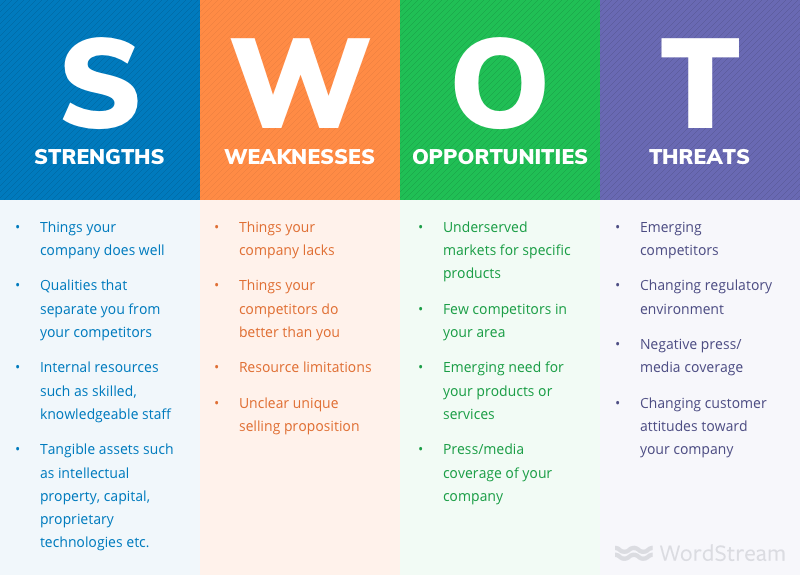
Conducting a SWOT analysis is a powerful way to evaluate your company or project, whether you’re two people or 500 people. In this article, you’ll learn: what a SWOT analysis is, see some SWOT analysis examples, and learn tips and strategies for conducting a comprehensive SWOT analysis of your own. You’ll also see how you can use the data a SWOT exercise yields to improve your internal processes and workflows, and get a free, editable SWOT analysis template.
The Complete Guide to SWOT Analysis:
Table of contents
What is a SWOT analysis?
A SWOT analysis is a technique used to determine and define your Strengths, Weaknesses, Opportunities, and Threats – SWOT.
SWOT analyses can be applied to an entire company or organization, or individual projects within a single department. Most commonly, SWOT analyses are used at the organizational level to determine how closely a business is aligned with its growth trajectories and success benchmarks, but they can also be used to ascertain how well a particular project – such as an online advertising campaign – is performing according to initial projections.
Whatever you choose to call them, SWOT analyses are often presented as a grid-like matrix with four distinct quadrants – one representing each individual element. This presentation offers several benefits, such as identifying which elements are internal versus external, and displaying a wide range of data in an easy-to-read, predominantly visual format.
Breaking down the SWOT analysis definition
We know that SWOT stands for Strengths, Weaknesses, Opportunities, and Threats – but what does each of these elements mean? Let’s take a look at each element individually.
Strengths
The first element of a SWOT analysis is Strengths.
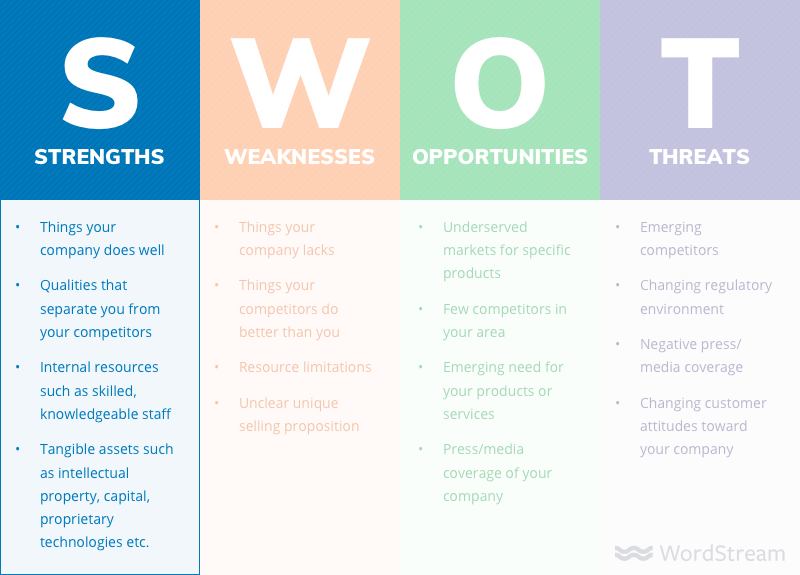
As you’ve probably guessed, this element addresses things that your company or project does especially well. This could be something intangible, such as your company’s brand attributes, or something more easily defined such as the unique selling proposition of a particular product line. It could also be your people, your literal human resources: strong leadership, or a great engineering team.
Weaknesses
Once you’ve figured out your strengths, it’s time to turn that critical self-awareness on your weaknesses.
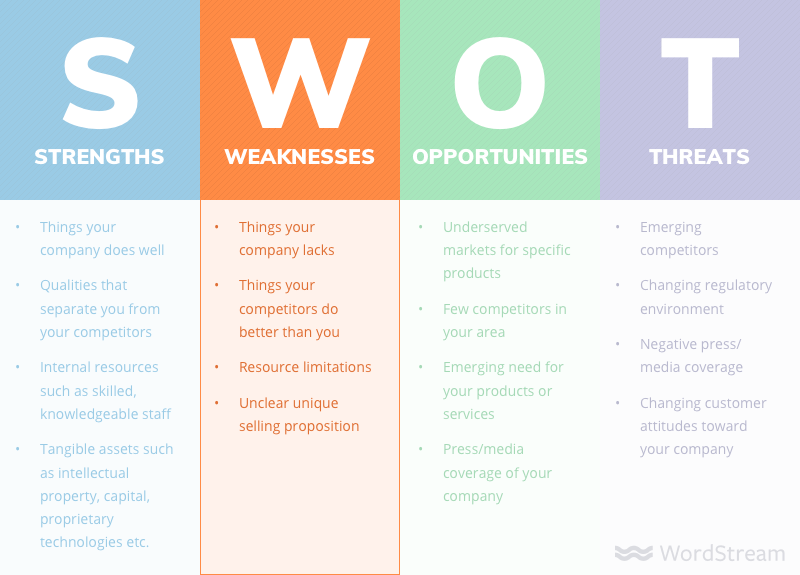
What’s holding your business or project back? This element can include organizational challenges like a shortage of skilled people and financial or budgetary limitations.
This element of a SWOT analysis may also include weaknesses in relation to other companies in your industry, such as the lack of a clearly defined USP in a crowded market.
Opportunities
Next up is Opportunities.
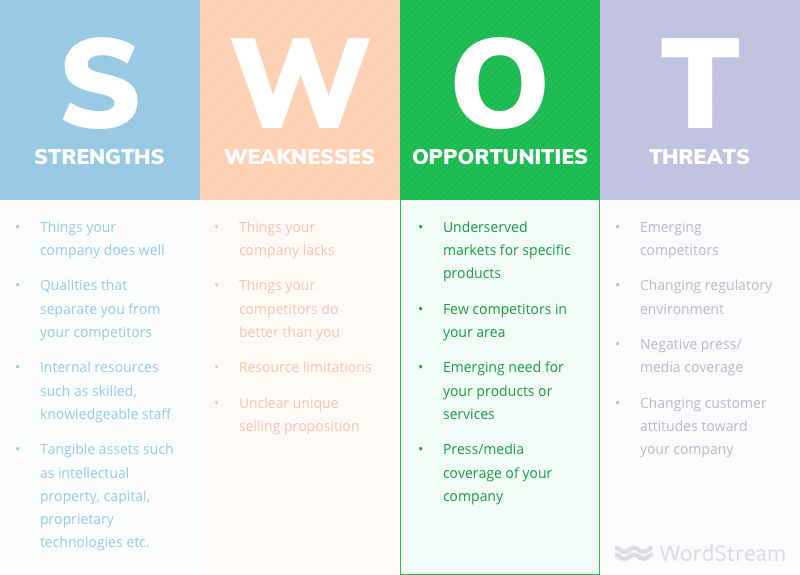
Can’t keep up with the volume of leads being generated by your marketing team? That’s an opportunity. Is your company developing an innovative new idea that will open up new markets or demographics? That’s another opportunity.
In short, this element of a SWOT analysis covers everything you could do to improve sales, grow as a company, or advance your organization’s mission.
Threats
The final element of a SWOT analysis is Threats – everything that poses a risk to either your company itself or its likelihood of success or growth.
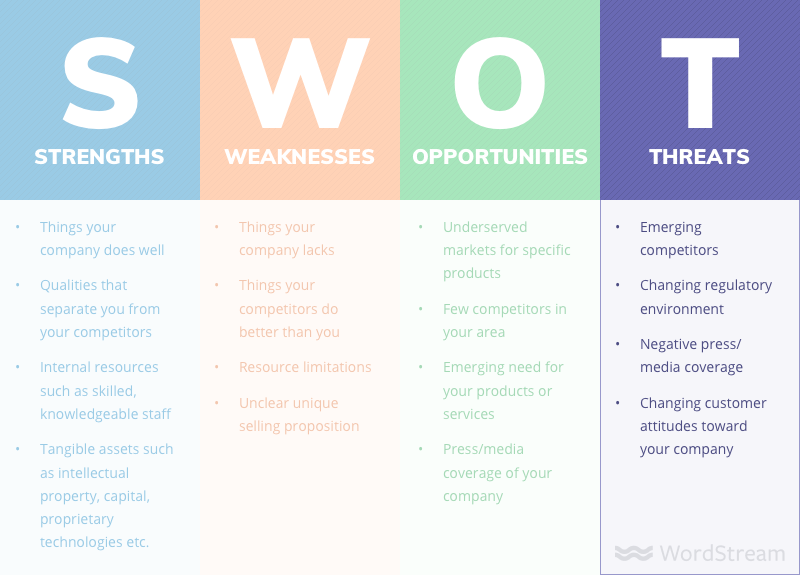
This could include things like emerging competitors, changes in regulatory law, financial risks, and virtually everything else that could potentially jeopardize the future of your company or project.
SWOT analysis internal and external factors
The four elements above are common to all SWOT analyses. However, many companies further compartmentalize these elements into two distinct subgroups: Internal and External.
Internal factors
Typically, Strengths and Weaknesses are considered internal factors, in that they are the result of organizational decisions under the control of your company or team. A high churn rate, for example, would be categorized as a weakness, but improving a high churn rate is still within your control, making it an internal factor.
External factors
Similarly, emerging competitors would be categorized as a threat in a SWOT analysis, but since there’s very little you can do about this, this makes it an external factor. This is why you may have seen SWOT analyses referred to as Internal-External Analyses or IE matrices.
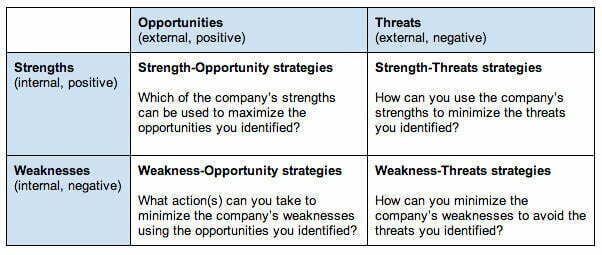
Subcategorizing your four primary elements into Internal and External factors isn’t necessarily critical to the success of your SWOT analysis, but it can be helpful in determining your next move or evaluating the degree of control you have over a given problem or opportunity.
Now that we know what each of the elements of a SWOT analysis means, let’s take a look at how to go about creating and conducting a SWOT analysis.
How to do a SWOT analysis
You can get the full experience in our video below, and this entire post is dedicated to answering that question, but for simplicity’s sake, here’s how to do a SWOT analysis:
SWOT analysis questions
Like feature-benefit matrices, there are several ways to conduct a SWOT analysis. However, regardless of how you choose to structure your analysis, we need to start by asking a series of questions. Here is a breakdown of the questions you should seek to answer when performing your SWOT analysis.
Strengths questions
Let’s take our first element, Strengths, for example. To determine what your strengths are as an organization, you could begin by asking some of the following questions:
By answering these questions, you’ll be in great shape to start identifying and listing your organization’s strengths.
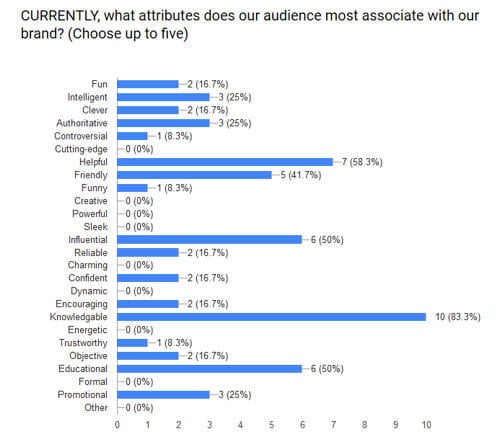
Positive brand attributes associated with WordStream, as identified by our customers
Weakness questions
We can use the same principle to determine your company’s weaknesses:
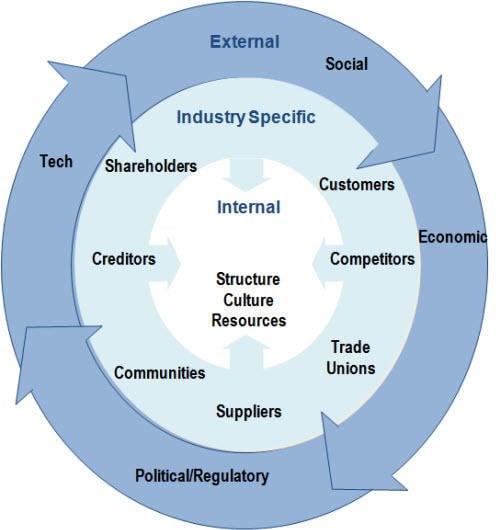
You may find that determining the strengths and weaknesses of your organization or project is considerably easier or takes less time than figuring out the opportunities and threats facing your company. This is because, as we said earlier, these are internal factors. External factors, on the other hand, may require more effort and rely upon more data, as these are often beyond your immediate sphere of influence.
Opportunities questions
Identifying opportunities and threats may require you to conduct in-depth competitive intelligence research about what your competitors are up to, or the examination of wider economic or business trends that could have an impact on your company. That’s not to say that opportunities and threats cannot be internal, however; you may discover opportunities and threats based solely on the strengths and weaknesses of your company. Some possible questions you could ask to identify potential opportunities might include:
Threat questions
When it comes to threats, you could certainly begin by asking a series of questions like those above. However, it’s often quite easy to come up with a list of potential threats facing your business or project without posing questions beforehand. This could include “branded” threats such as emerging or established competitors, broader threats such as changing regulatory environments and market volatility, or even internal threats such as high staff turnover that could threaten or derail current growth.
What is PEST analysis?
While we’re on the topic of internal versus external factors, I wanted to mention a tangential but entirely separate type of analysis closely relevant to SWOT analyses, known as a PEST analysis.
Earlier, I mentioned that external factors such as changing regulatory policies and market volatility could be considered threats in a standard SWOT analysis. However, despite their importance, challenges like this are often highly nuanced and driven by dozens or hundreds of individual factors. This can place them beyond the scope or intent of a typical SWOT analysis. This is why many companies also conduct PEST analyses.
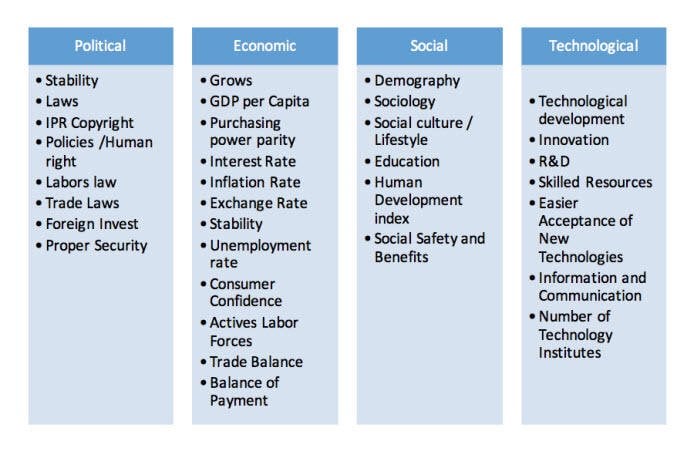
This type of analysis is not what an exterminator does upon arriving at a roach-infested tenement. Rather, a PEST analysis functions very similarly to a SWOT analysis, only they’re concerned with four external factors:
Pros of PEST analysis
One of the main reasons it’s worth looking at PEST analyses is because many of the factors that could end up in a PEST matrix could also be relevant to the Opportunities and Threats in our SWOT analysis. The kind of political and economic turmoil we’ve seen in the United States during the past year, for example, could very well pose legitimate and serious threats to many businesses (as well as some opportunities), but these kinds of obstacles tend to be much more complicated than the opportunities and threats you’d see in most SWOT analyses, given their broader scale and often-complex underlying factors.
Cons of PEST analysis
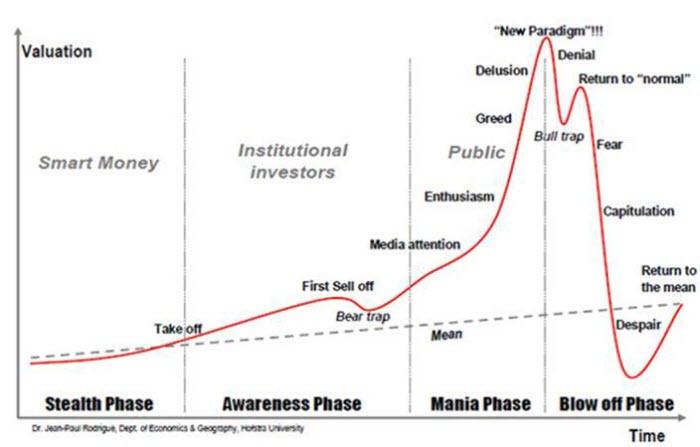
Obstacles identified in a typical PEST analysis also tend to be on much longer timeframes – it’s a lot easier and quicker to try and overcome internal challenges like high staff turnover than it is to wait and see if the economy picks up (or if the bubble will burst again). That’s why many larger companies conduct both SWOT and PEST analyses simultaneously – the SWOT analysis provides them with more immediate, potentially actionable roadmaps, whereas PEST analyses can be highly valuable when it comes to formulating longer-term plans and business strategies.
Benefits of SWOT analysis for small businesses
If you’re a marketer or small-business owner, you might be wondering if SWOT analyses are practical or even feasible for smaller companies and organizations. Although there is definitely a resource overhead involved in the creation of a SWOT analysis, there are many benefits in doing so, even for the smallest of companies.
Here’s an example of a project SWOT analysis:
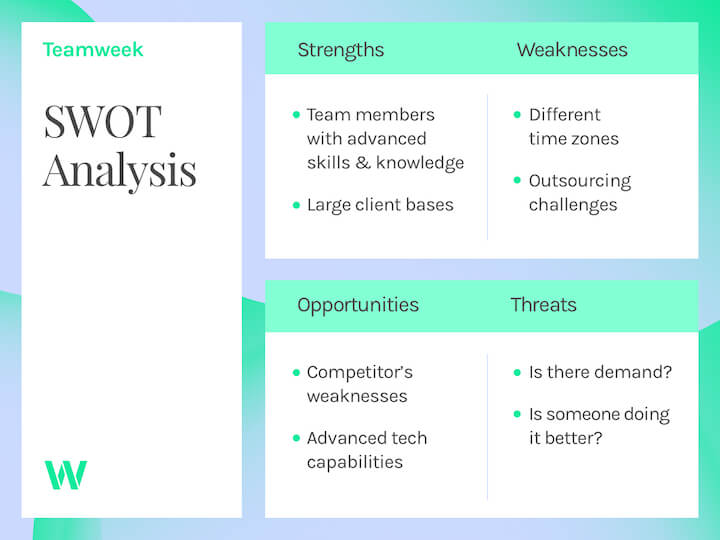
A full SWOT analysis example
So, now we know what each element of a SWOT analysis is concerned with and the kinds of exploratory questions we can ask to get the ball rolling, it’s time to actually get to work and create your SWOT analysis.
To illustrate how it works, we’ll create our own SWOT analysis example: a family-owned restaurant, with a single location, operating in an urban area.
Here’s the SWOT analysis example based on our fictional restaurant:
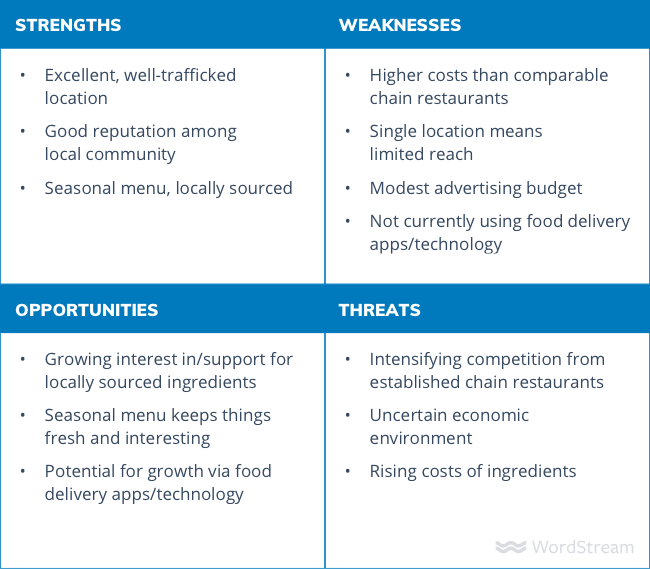
As you can see, this matrix format allows you to quickly and easily identify the various elements you’ve included in your analysis.
Strengths examples
Weakness examples
Opportunity examples
Threat examples
SWOT analysis example: Acting on your results
So, you’ve finally got your hands on a completed SWOT matrix. You’ve identified internal strengths and weaknesses, as well as external opportunities and threats. You’ve begun to see your company in a whole new light.
Ideally, there are two stages of action you should take upon completing a SWOT analysis. First, you should attempt to match your strengths with your opportunities. Next, you should try to convert weaknesses into strengths. Let’s take a look how this works.
1. Harness your strengths
One of the best things about the strengths you identified in your SWOT analysis is that you’re already doing them.
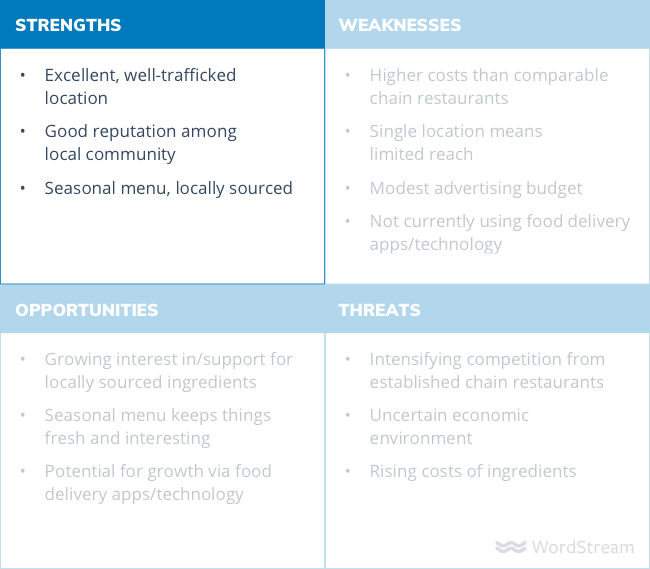
In our example above, the restaurant’s location, reputation, and seasonal menu are all strengths. This tells the fictitious company that it should continue to experiment with its popular seasonal menu. It also tells the company it should continue to develop and nurture the strong relationships with its regular customers that have strengthened the restaurant’s reputation in the community.
Essentially, acting upon your business’ strengths consists of “do more of what you’re already good at.”
2. Shore up your weaknesses
Acting on the weaknesses you identified in your SWOT analysis is a little trickier, not least because you have to be honest enough with yourself about your weaknesses in the first place.
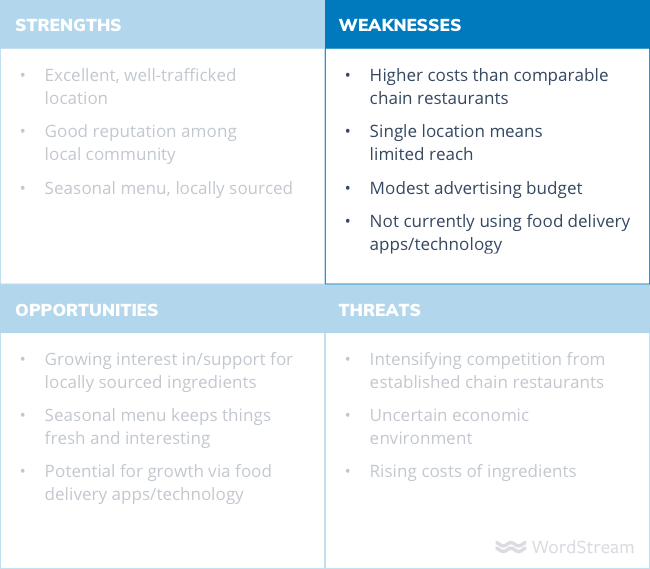
Going back to our example, some of these weaknesses are very challenging to act upon. Going up against the considerable purchasing power of rival chain restaurants can be very difficult for smaller, family owned businesses. The restaurant is also struggling with its limited reach, the restrictions of a modest advertising budget, and is also failing to leverage the potential to increase sales by allowing customers to order food online through delivery apps like Foodler or GrubHub.
However, that’s not to say all hope is lost. It might be harder for our example business to compete with a chain, but there are plenty of other ways small companies can be more competitive – such as by developing strong, meaningful relationships with customers, which was not only one of the company’s strengths, but also something chain restaurants simply cannot offer.
3. Seize opportunities
The Opportunities section of your SWOT analysis is by far the most actionable, and that’s by design. By identifying opportunities by evaluating your organization’s strengths, you should have a ready-made list of targets to aim for.
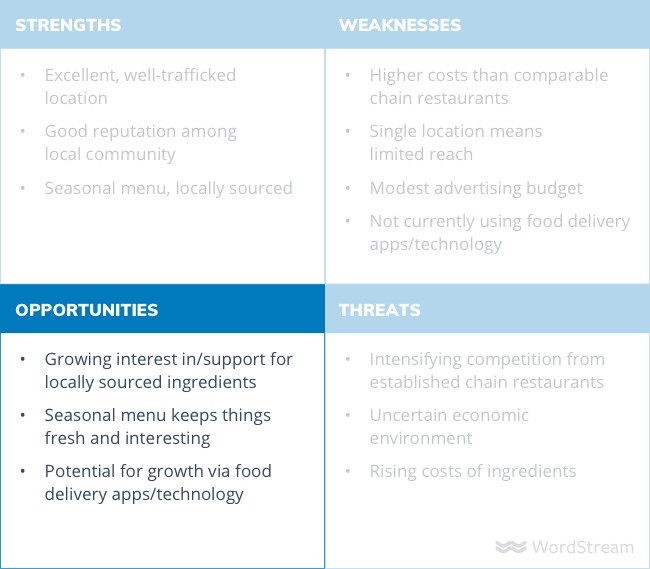
In the example above, increasing consumer appetites for ethically produced, locally grown ingredients is a major opportunity. However, our restaurateurs cannot rest on their laurels – there’s still work to be done. In this example, this may involve investing in technical expertise to take advantage of the opportunities presented by food delivery apps, or sourcing locally grown produce more aggressively in an attempt to reduce costs.
It’s also important to avoid hubris or complacency in your opportunities. Even if you have an iron-clad advantage over every other business in your industry, failing to devote sufficient time, money, or personnel resources in maintaining that advantage may result in you missing out on these opportunities over time.
Every business’ opportunities will differ, but it’s vital that you create a clearly defined roadmap for capitalizing upon the opportunities you’ve identified, whether they be internal or external.
4. Mitigate threats
Anticipating and mitigating the threats identified in your SWOT analysis may be the most difficult challenge you’ll face in this scenario, primarily because threats are typically external factors; there’s only so much you can do to mitigate the potential damage of factors beyond your control.
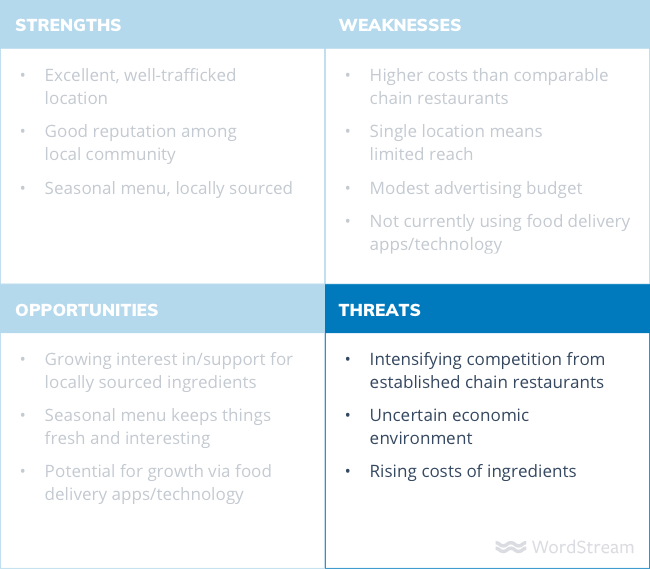
Every threat, and the appropriate reaction to that threat, is different. Regardless of the specific threats you’ve identified in your SWOT analysis, responding to and monitoring those threats should be among your very top priorities, irrespective of the degree of control you have over those threats.
In the example above, all three threats are particularly challenging. To compete with the prices of its chain competitors, our restaurateurs may be forced to either compromise on their values to secure cheaper ingredients, or willingly cut into their profit margins to remain competitive. Similarly, economic uncertainty is virtually impossible to fully mitigate, making it a persistent threat to the stability of our example restaurant business.
In some SWOT analyses, there may be some overlap between your opportunities and threats. For example, in the analysis above, the popularity of locally sourced ingredients was identified as an opportunity, and heightened competition was identified as a threat. In this example, highlighting the restaurant’s relationships with local farmers – further reinforcing the restaurant’s commitment to the local community and regional economy – may be an effective way for our restaurateurs to overcome the threat posed by the increasingly desperate chain restaurants vying for their customers.
When compiling the results of your SWOT analysis, be sure to look for areas of crossover like this and see if it’s possible to seize an opportunity and reduce a threat at the same time.
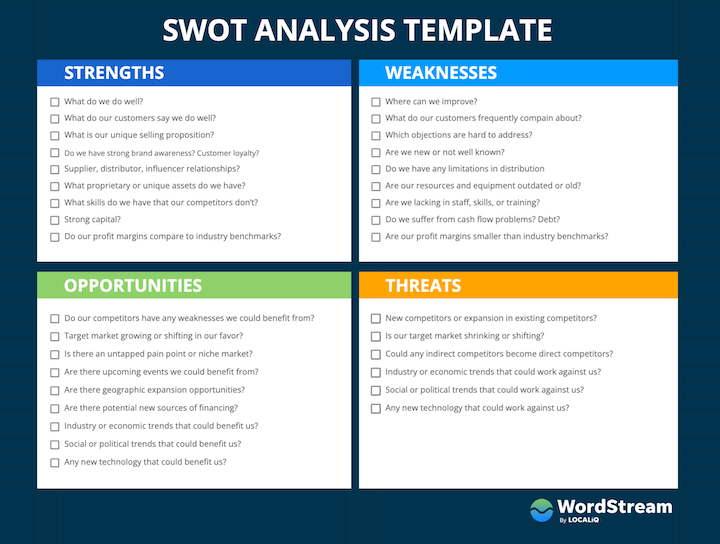
Free SWOT Analysis template
Ready to put it all into practice for your own business? Here’s our free, editable, SWOT analysis template.
It’s a Google Sheet so you can add and remove rows, edit and answer the questions, paste into a slide deck, and more.
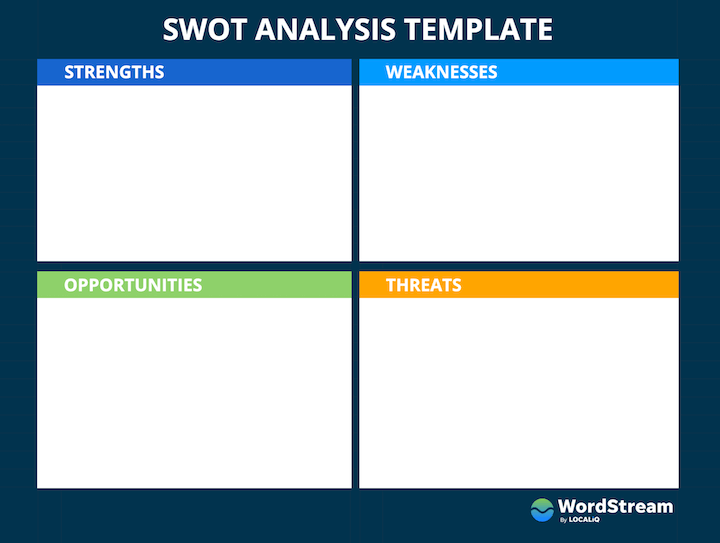
We’ve also thrown a blank one in there too:
Meet The Author
Dan Shewan
Originally from the U.K., Dan Shewan is a journalist and web content specialist who now lives and writes in New England. Dan’s work has appeared in a wide range of publications in print and online, including The Guardian, The Daily Beast, Pacific Standard magazine, The Independent, McSweeney’s Internet Tendency, and many other outlets.
See other posts by Dan Shewan

More Articles Like This

118 Creative Blog Post Ideas for Businesses (With Examples & Templates!)
Put that thinking cap on a shelf. You won’t need it again. Ever.

60+ Easy & Engaging August Marketing Ideas (With Examples)
Ideas for blog, social media posts, promos, and more!

8 Ways to Use Color Psychology in Marketing (With Examples)
Did you know that orange is optimistic? Blue is true? Yellow is *not* mellow?
Comments
Please read our Comment Policy before commenting.
SWOT Analysis
Understanding Your Business, Informing Your Strategy
What Is a SWOT Analysis?
SWOT stands for Strengths, Weaknesses, Opportunities, and Threats, and so a SWOT analysis is a technique for assessing these four aspects of your business.
SWOT Analysis is a tool that can help you to analyze what your company does best now, and to devise a successful strategy for the future. SWOT can also uncover areas of the business that are holding you back, or that your competitors could exploit if you don’t protect yourself.
A SWOT analysis examines both internal and external factors – that is, what’s going on inside and outside your organization. So some of these factors will be within your control and some will not. In either case, the wisest action you can take in response will become clearer once you’ve discovered, recorded and analyzed as many factors as you can.
In this article, video and infographic, we explore how to carry out a SWOT analysis, and how to put your findings into action. We also include a worked example and a template to help you get started on a SWOT analysis in your own workplace.
Why Is SWOT Analysis Important?
SWOT Analysis can help you to challenge risky assumptions and to uncover dangerous blindspots about your organization’s performance. If you use it carefully and collaboratively, it can deliver new insights on where your business currently is, and help you to develop exactly the right strategy for any situation.
For example, you may be well aware of some of your organization’s strengths, but until you record them alongside weaknesses and threats you might not realize how unreliable those strengths actually are.
Equally, you likely have reasonable concerns about some of your business weaknesses but, by going through the analysis systematically, you could find an opportunity, previously overlooked, that could more than compensate.
How to Write a SWOT Analysis
SWOT analysis involves making lists – but so much more, too! When you begin to write one list (say, Strengths), the thought process and research that you’ll go through will prompt ideas for the other lists (Weaknesses, Opportunities or Threats). And if you compare these lists side by side, you will likely notice connections and contradictions, which you’ll want to highlight and explore.
You’ll find yourself moving back and forth between your lists frequently. So, make the task easier and more effective by arranging your four lists together in one view.
Draw up a SWOT Analysis matrix, or use our free downloadable template.
A SWOT matrix is a 2×2 grid, with one square for each of the four aspects of SWOT. (Figure 1 shows what it should look like.) Each section is headed by some questions to get your thinking started.
Figure 1. A SWOT Analysis Matrix.
Strengths
What do you do well?
What unique resources can you draw on?
What do others see as your strengths?
Weaknesses
What could you improve?
Where do you have fewer resources than others?
What are others likely to see as weaknesses?
Opportunities
What opportunities are open to you?
What trends could you take advantage of?
How can you turn your strengths into opportunities?
Threats
What threats could harm you?
What is your competition doing?
What threats do your weaknesses expose to you?
How to Do a SWOT Analysis
Avoid relying on your own, partial understanding of your organization. Your assumptions could be wrong. Instead, gather a team of people from a range of functions and levels to build a broad and insightful list of observations.
Then, every time you identify a Strength, Weakness, Opportunity, or Threat, write it down in the relevant part of the SWOT analysis grid for all to see.
Let’s look at each area in more detail and consider what fits where, and what questions you could ask as part of your data gathering.
Strengths
Strengths are things that your organization does particularly well, or in a way that distinguishes you from your competitors. Think about the advantages your organization has over other organizations. These might be the motivation of your staff, access to certain materials, or a strong set of manufacturing processes.
Your strengths are an integral part of your organization, so think about what makes it «tick.» What do you do better than anyone else? What values drive your business? What unique or lowest-cost resources can you draw upon that others can’t? Identify and analyze your organization’s Unique Selling Proposition (USP), and add this to the Strengths section.
Then turn your perspective around and ask yourself what your competitors might see as your strengths. What factors mean that you get the sale ahead of them?
Remember, any aspect of your organization is only a strength if it brings you a clear advantage. For example, if all of your competitors provide high-quality products, then a high-quality production process is not a strength in your market: it’s a necessity.
Weaknesses
Weaknesses, like strengths, are inherent features of your organization, so focus on your people, resources, systems, and procedures. Think about what you could improve, and the sorts of practices you should avoid.
Once again, imagine (or find out) how other people in your market see you. Do they notice weaknesses that you tend to be blind to? Take time to examine how and why your competitors are doing better than you. What are you lacking?
Be honest! A SWOT analysis will only be valuable if you gather all the information you need. So, it’s best to be realistic now, and face any unpleasant truths as soon as possible.
Opportunities
Opportunities are openings or chances for something positive to happen, but you’ll need to claim them for yourself!
They usually arise from situations outside your organization, and require an eye to what might happen in the future. They might arise as developments in the market you serve, or in the technology you use. Being able to spot and exploit opportunities can make a huge difference to your organization’s ability to compete and take the lead in your market.
Think about good opportunities that you can exploit immediately. These don’t need to be game-changers: even small advantages can increase your organization’s competitiveness. What interesting market trends are you aware of, large or small, which could have an impact?
You should also watch out for changes in government policy related to your field. And changes in social patterns, population profiles, and lifestyles can all throw up interesting opportunities.
Threats
Threats include anything that can negatively affect your business from the outside, such as supply-chain problems, shifts in market requirements, or a shortage of recruits. It’s vital to anticipate threats and to take action against them before you become a victim of them and your growth stalls.
Think about the obstacles you face in getting your product to market and selling. You may notice that quality standards or specifications for your products are changing, and that you’ll need to change those products if you’re to stay in the lead. Evolving technology is an ever-present threat, as well as an opportunity!
Always consider what your competitors are doing, and whether you should be changing your organization’s emphasis to meet the challenge. But remember that what they’re doing might not be the right thing for you to do. So, avoid copying them without knowing how it will improve your position.
Be sure to explore whether your organization is especially exposed to external challenges. Do you have bad debt or cash-flow problems, for example, that could make you vulnerable to even small changes in your market? This is the kind of threat that can seriously damage your business, so be alert.
Use PEST Analysis to ensure that you don’t overlook threatening external factors. And PMESII-PT is an especially helpful check in very unfamiliar or uncertain environments.
Frequently Asked Questions About SWOT
1. Who Invented SWOT Analysis?
Many people attribute SWOT Analysis to Albert S. Humphrey. However, there has been some debate on the originator of the tool, as discussed in the International Journal of Business Research.
2. How Do SWOT Analysis and the TOWS Matrix compare?
While SWOT analysis puts the emphasis on the internal environment (your strengths and weaknesses), TOWS forces you to look at your external environment first (your threats and opportunities). In most cases, you’ll do a SWOT Analysis first, and follow up with a TOWS Matrix to offer a broader context.
3. What Are the Biggest SWOT Analysis Mistakes?
Free Workbook Offer
Increase your productivity and reduce stress with this FREE workbook when you join the Club before midnight, Aug 21.


Get the Free Newsletter
Learn essential career skills every week, plus get a bonus Essential Strategy Checklist, free!
How to Use a SWOT Analysis
Use a SWOT Analysis to assess your organization’s current position before you decide on any new strategy. Find out what’s working well, and what’s not so good. Ask yourself where you want to go, how you might get there – and what might get in your way.
Once you’ve examined all four aspects of SWOT, you’ll want to build on your strengths, boost your weaker areas, head off any threats, and exploit every opportunity. In fact, you’ll likely be faced with a long list of potential actions.
But before you go ahead, be sure to develop your ideas further. Look for potential connections between the quadrants of your matrix. For example, could you use some of your strengths to open up further opportunities? And, would even more opportunities become available by eliminating some of your weaknesses?
Remember to apply your learnings at the right level in your organization. For example, at a product or product-line level, rather than at the much vaguer whole-company level. And use your SWOT analysis alongside other strategy tools (for example, Core Competencies Analysis ), so that you get a comprehensive picture of the situation you’re dealing with.
«How to Use SWOT» video. Click here to view a transcript.
A SWOT Analysis Example
Imagine this scenario: a small start-up consultancy wants a clear picture of its current situation, to decide on a future strategy for growth. The team gathers, and draws up the SWOT Analysis shown in Figure 2.
Figure 2. A Completed SWOT Analysis.
Strengths
What do you do well?
What unique resources can you draw on?
What do others see as your strengths?
Weaknesses
What could you improve?
Where do you have fewer resources than others?
What are others likely to see as weaknesses?
Opportunities
What opportunities are open to you?
What trends could you take advantage of?
How can you turn your strengths into opportunities?
Threats
What threats could harm you?
What is your competition doing?
What threats do your weaknesses expose to you?
As a result of the team’s analysis, it’s clear that the consultancy’s main strengths lie in its agility, technical expertise, and low overheads. These allow it to offer excellent customer service to a relatively small client base.
The company’s weaknesses are also to do with its size. It will need to invest in training, to improve the skills base of the small staff. It’ll also need to focus on retention, so it doesn’t lose key team members.
There are opportunities in offering rapid-response, good-value services to local businesses and to local government organizations. The company can likely be first to market with new products and services, given that its competitors are slow adopters.
The threats require the consultancy to keep up-to-date with changes in technology. It also needs to keep a close eye on its largest competitors, given its vulnerability to large-scale changes in its market. To counteract this, the business needs to focus its marketing on selected industry websites, to get the greatest possible market presence on a small advertising budget.
SWOT Analysis Infographic
Click on the image below to see SWOT Analysis represented in an infographic:

Key Points
SWOT Analysis helps you to identify your organization’s Strengths, Weaknesses, Opportunities, and Threats.
It guides you to build on what you do well, address what you’re lacking, seize new openings, and minimize risks.
Apply a SWOT Analysis to assess your organization’s position before you decide on any new strategy.
Use a SWOT matrix to prompt your research and to record your ideas. Avoid making huge lists of suggestions. Be as specific as you can, and be honest about your weaknesses.
Be realistic and rigorous. Prune and prioritize your ideas, to focus time and money on the most significant and impactful actions and solutions. Complement your use of SWOT with other tools.
Collaborate with a team of people from across the business. This will help to uncover a more accurate and honest picture.
Find out what’s working well, and what’s not so good. Ask yourself where you want to go, how you might get there – and what might get in your way.
This site teaches you the skills you need for a happy and successful career; and this is just one of many tools and resources that you’ll find here at Mind Tools. Subscribe to our free newsletter, or join the Mind Tools Club and really supercharge your career!